News
March 16 Council hearing on White Stadium budget
Opponents get emotional
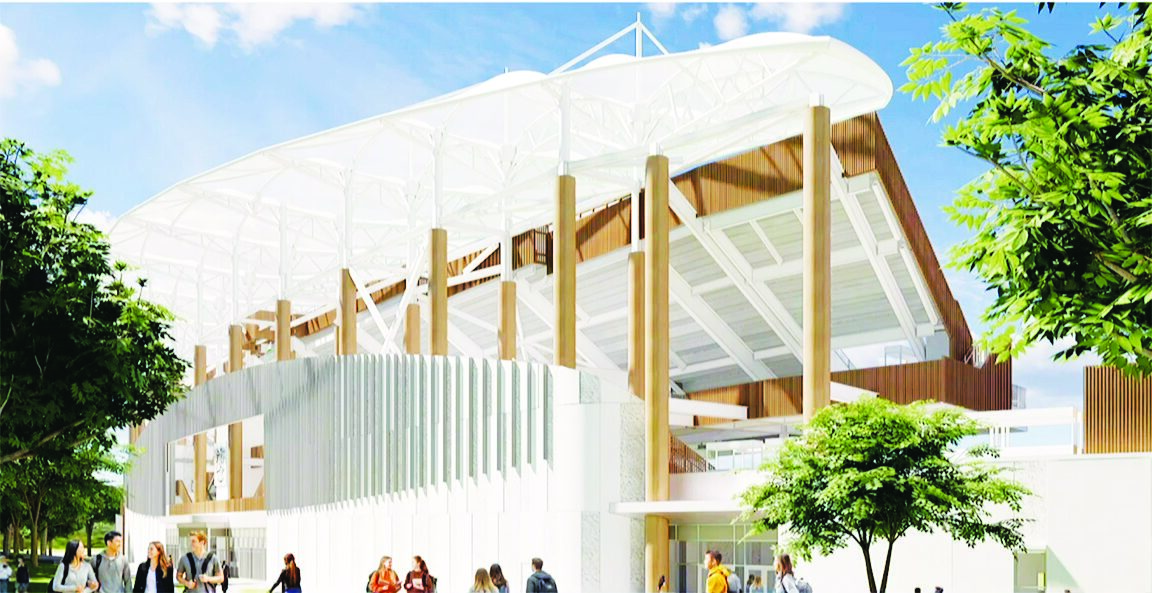
On January 28 City Councilor Ben Weber filed an order “to review construction costs associated with White Stadium.” This was nine days before Mayor Wu announced at a Feb. 6 press conference that the cost for the city’s east grandstand half of the stadium was $135 million.
According to The Boston Herald, a contract and a building permit were awarded to Bond Construction on Jan. 8. Construction alone, according to the March 2 Herald, is $79 million.
A second-term councilor, Weber represents District 6 that includes Jamaica Plain that arguably will take the brunt of the Legacy women’s soccer games, especially Egleston Square.
The hearing of the Post Audit Committee on March 16 was not well-advertised; The Bulletin heard about it by chance from a South End source the night before. It was chaired by City Councilor John Fitzgerald and committee co-chair Sharon Durkan.
Committee member Julia Mejia seemingly wanted to control the hearing because she invited five panelists – all opponents – to testify. But Ricky Thompson, chair of the Franklin Park Coalition, which supports the White Stadium partnership, appeared and was given a seat at the table.
Weber opened the hearing.
“I filed the docket to hear about the cost of the stadium,” he said. “Why is it costing so much? The price tag is a lot, no question about it.”
Four senior administration staff involved with White Stadium followed the community panelists: Chief of Operations Dion Irish, Deputy Chief of Urban Design Diana Fernandez Bibeau, Pubic Facilities Executive Director Carleton Jones, and BPS Deputy Superintendent of Operations Samuel De Pina.
They shed a little more detail on the budget, construction costs and community benefits, but the public testimony was a twice-told tale only more shrill: 12 testified in opposition.
Mejia set the stage immediately.
“I do not support the renovation of White Stadium that’s going to do it on the backs of black and brown children,” she said, “I don’t see suburbanites walking down to Egleston Square.”
Laurie Radwin of Roslindale swooped in and equated White Stadium with Squares+Streets (S+S) zoning revisions, quoting Martin Luther King’s “injustice everywhere” statement.
But Fernandez Bibeau, in her customary measured manner, repeated what she has said for nearly three years, “This is decades in the making.” She continued while showing an elevation drawing of the East Stadium and floor plans, “The project is really complex.”
She explained the variety of interior spaces and uses. “How to get creative to build a truly city-wide athletic facility... no one has taken this on because it’s been difficult to achieve.”
“Investing $135 million for BPS students is worth every dollar,” she said.
Mejia shot back. “For the record, the renderings have no people of color in the renderings. Is that intentional?” she asked. “Black students will not be there? I’m not being petty. I’m standing up for my people.”
Moody Nolan are the designers of the East Stadium and boast being the largest Black-owned architectural firm in the country.
Amateur architect Alan Ihrer of Williams Street maintained in his testimony that, “Ninety percent of the seats are on top of the track” and cannot see the track. “This is diabolical, a piece of junk.”
Fernandez Bibeau said this wasn’t true and showed a plan of the full stadium on the screen share to illustrate it.

Priscilla Andrade, one of Mejia’s invitees, turned up the volume. “This partnership is power hoarding,” she said, “It’s white supremacist culture.”
Janelle Graham said she lived in Jamaica Plain. “I’m appalled that this is happening. How much is going to bribes, to payouts? This is offensive. Talking out of three tongues,” Graham said.
Reggie Stewart said that White Stadium is a “continuation of racist government” alongside parcel P3, Madison Park and Blue Hill Avenue [busway].
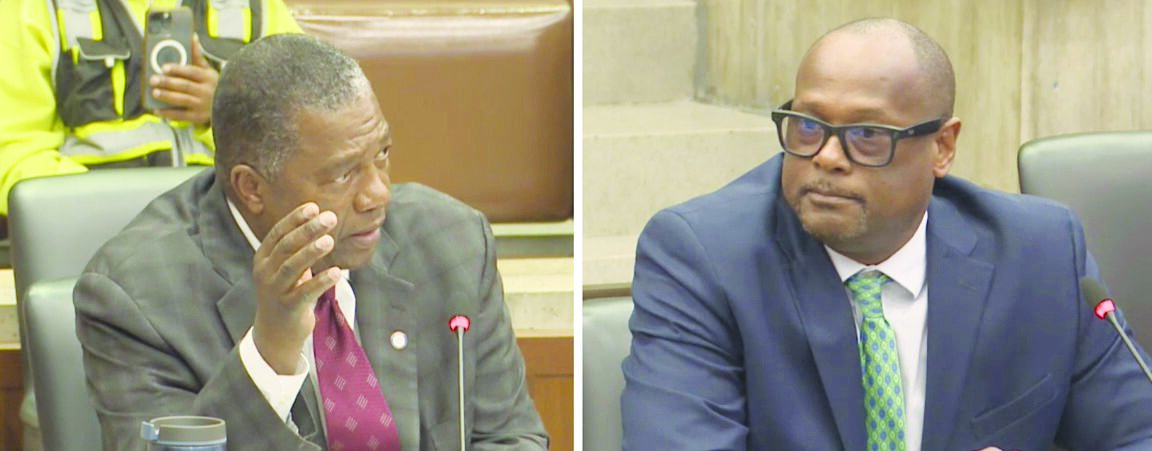
Freshman City Councilor Miniard Culpepper of District 7 brought the hearing down to earth. “I’m worried about impediments to minority contractors,” he said to Irish. “These have historically been left out.”
Irish assured Culpepper that those contractors would be hired. “In the last fiscal year, $227,000 in contracts have been awarded with 12 percent going to minority- and women-owned business.”
On the screen share Irish showed a slide: “$102 million in total contracts have been awarded across both sides of the project including $43 million committed to MBWE firms.”
“$10 million upcoming contract opportunities for interested MWBE and local firms,” Irish said.
Jones added that Bond “is contracting with suppliers directly. We’re tracking the investment for MBWE contractors.”
Irish added that “a lot has been learned from White Stadium contractor experience.”
A few supporters snuck into the hearing including Marvin Mathelier of Egleston Square and Robby Ficker of South Boston.
“The opposition is exclusively reactionary,” Flicker said, “using students as a political prop. There’s no better way to be spending my tax dollars than the White Stadium for women’s sports.”
The hearing went on for four hours with often redundant histrionics: “Wu is supported by her rubber-stamping puppets and hyperbole” with “no concerns for the disproportionate environmental burden on the majority Black community around White Stadium.”
It was difficult to learn what was achieved, especially since White Stadium construction is well underway. What seems certain is that the constituency for Franklin Park is permanently polarized.
Committee co-chair Sharon Durkan [Fitzgerald had already left the building] called for a concluding statement from Weber.
“There’s lot of opposition and a lot of support,” he said. “White Stadium hasn’t been usable for a long time. I join my neighbors in uplifting women’s sports.” But he cautioned, “We will have to clearly monitor contingency spending since it can push above what is currently budgeted.”
Comments