News
City noncommittal on Beacon St. bike lane
Protected bike lanes promised in Brighton, but when?
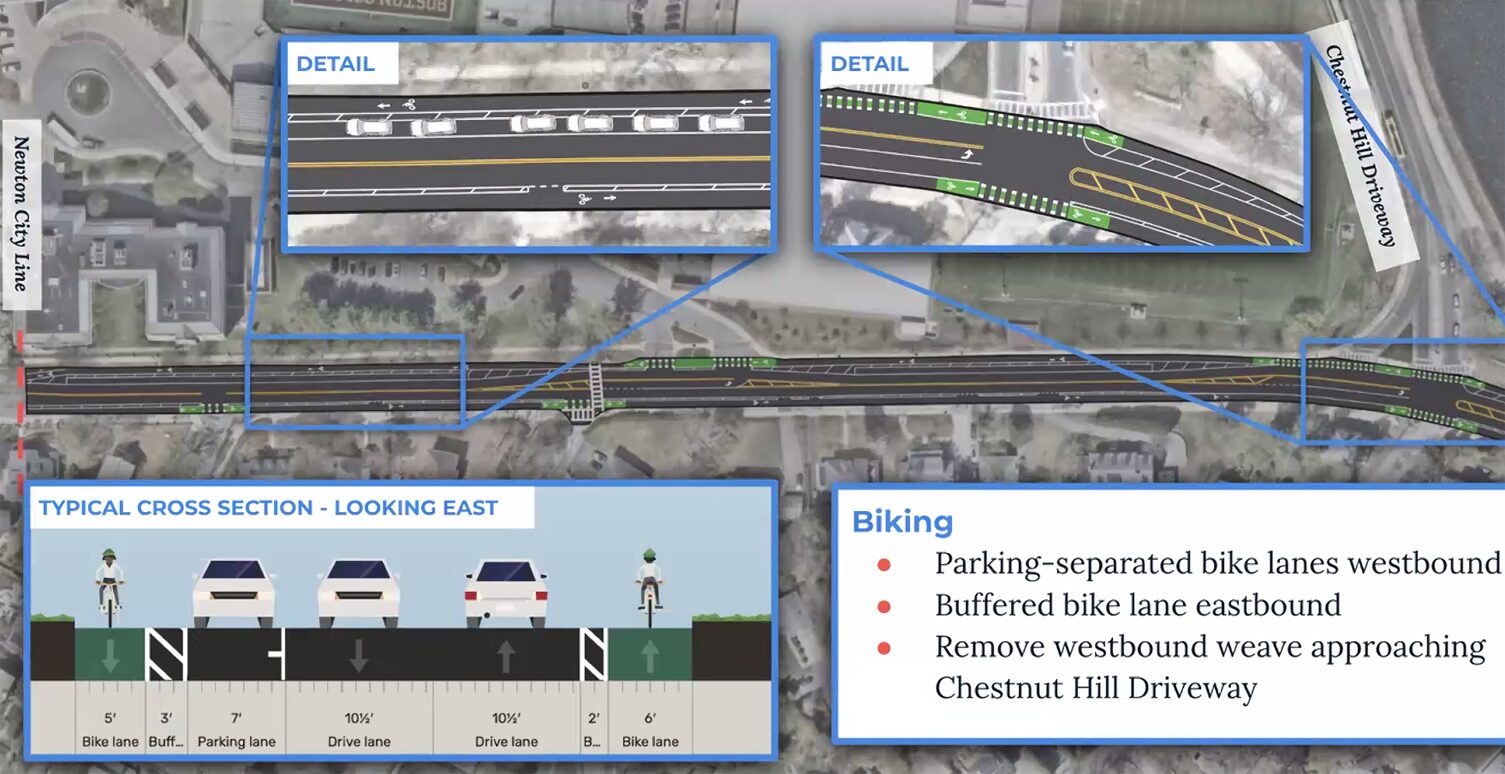
The City of Boston hosted a virtual meeting last Wednesday on proposed safety improvements to Beacon Street in Brighton in between the Newton line and Cleveland Circle.
City officials were adamant that the work was focused on Brighton Street, and that other work is already planned and underway to improve the sea of potholes that is currently Cleveland Circle – https://gvimes.link/clevcir – by the MBTA, the city, National Grid, and Boston Water and Sewer. Boston Chief Engineer Construction Manager Norman Parks said that Cleveland Circle will see better days coming, but with all that work being completed, buttoned up and then repaved, those days are still a couple of years off, likely 2028.
“There is a lot to do with this area that is being coordinated through the City of Boston and the MBTA,” he said.
Deputy Director for Capital Project Planning Nathaniel Fink said the scope is further limited by its scope and nature.
“This is part of a routine asphalt resurfacing program, and that comes with some targeted sidewalk improvements and curb ramp repairs,” he said. “The specific scope of work is to repave the road surface curb to curb, install a new pavement marking and signage plan with an updated design – and that is the bulk of our presentation tonight, that design – we will be making standard (Americans with Disabilities Act) ADA upgrades to curb ramps in the area and we are also making targeted sidewalk repairs.”
Fink and Lead Planner Maddie Webster said the city is looking to start construction around the end of June and finish before the end of the summer, to accommodate Boston College. The city said they consulted with BC, but no representative from the school was on the call.
Residents were mostly concerned with the prospect of a bike lane and the proposed traffic calming measures the city is planning on installing. Those measures include the usual vehicle-slowing measures, with the notable exception of any speed humps and raised crosswalks. Fink was asked about the lack of a raised crosswalk on the stretch of road, and while he said he wants to put raised crosswalks into every situation he can, the scope of the project was for repaving only, and a raised crosswalk would require drainage improvements because how such a structure affects waterflow.
The biggest point of contention was the bike lane. The plan proposes painting lines for a bike lane – protected by parking spaces where available, but just marked by paint where not – to conform with the lane currently in operation at Newton. It would also narrow the road to help slow traffic – an extremely common tactic in traffic calming.
“Currently the lanes are (sized) closer to what we would see on a highway, where people are comfortable driving at much higher speeds,” said Boston Transportation Planner Daniel Merrow. “Currently the intent is to keep people driving 25 miles per hour, and the lane sizes reflect that.”

Residents said they were concerned about the fact that large portions of the bike lanes would not be initially protected by anything but a paint line. Fink said he agreed that protection is needed, but did not commit to any timeline or method of protection – e.g., flex posts of cast concrete.
“We are facing a relatively short timeline for construction; our construction management colleagues want to get this work sometime in mid-June, which is largely reflective of the college schedule,” he said. “Boston College, both for their classes as well as getting the bulk of the work completed before folks come back to school and certainly before the football season… We hear all your questions loud and clear about protection, and it is something we are looking into, but at this time I can’t make any guarantees about a specific timeline on that other than I can say that we are doing our best to leave as many places as there is space for it… We are absolutely building it to ‘future proof’ it.”
Resident Eva Webster objected to the road narrowing and flex posts.
“I would like to point out that many of us consider those flex posts eye sores that conflict with the beauty of the landscape,” she said. “The other thing I would like to bring up is that in the presentation it was mentioned multiple times that the lanes were being narrowed as if it was a good thing. I think when car lanes are too narrow, it is a safety issue for cars, because it increases the chances that cars might hit head on. Unless it is absolutely necessary to narrow those lanes, I would advocate for keeping them reasonably wide, because it’s not a typical urban street.”
Resident Marcos Rodriguez said he wanted to emphasize the importance of even flex posts.
“I would love to see some sort of separation on the unprotected areas; cars will just use it to park and swerve, which we’ve seen around Boston with the removal of the protection,” he said, referencing the recent Boylston Street removal of such protections. “I personally have been attacked by a driver because I’ve had to go around a bike lane that was blocked and unusable. I want to show that importance, because they probably would have saved me from getting punched in the face.”
For more information on the project, go to https://gvimes.link/beaconsafe
About the author
Jeff Sullivan Covers local news and community stories.
Comments