News
BZC approves two new S+S zones
Amendment informed by citizens’ petition
On Dec. 10, the Boston Zoning Commission (BZC) voted unanimously – after holding a virtual public hearing – to add two new Squares + Streets (S+S) zoning districts to the six already in the citywide code. Their approval marked the latest update to Mayor Michelle Wu’s initiative to increase residential development in neighborhood business districts selected by City Hall.
It also served as a milestone for what has been a contentious and lengthy community engagement process regarding the Planning Department’s S+S rezoning of Hyde Park’s Cleary Square.
Cleary Square and Roslindale Square were the first neighborhood downtowns/main streets selected for the initiative, and when the Planning Department released the draft amendment (Article 26) proposing six new S+S zoning districts in early December of 2023, there were many concerns regarding their potential negative impacts, as well as how much meaningful input the community would have in determining which of those zones would go where.
Those concerns were informed by the fact that the loosened restrictions of the S+S zones allow for greatly increased height and density in new residential development – and a possible reduction of active use/commercial space in the areas where they are mapped. The districts would also reduce, if not eliminate, any binding community input built into the zoning relief process, as the Zoning Board of Appeals would not get as many zoning variance requests.
The planning process for Cleary Square officially kicked off in February of 2024 and the BZC adopted Article 26 into the citywide code that April. Throughout the year, the Planning Department held many public meetings and community outreach events while, some feel, avoiding publicly addressing those reiterated zoning concerns in any sort of detailed way as things moved forward.
In response, that summer a volunteer ad hoc committee drafted a citizens’ petition in which it proposed changes to Article 26. It focused on protecting business space in Cleary Square from being taken away, guarding against residential and business displacement, addressing concerns raised by the S+S zones having no minimum parking requirement, and the environment.
Over roughly the next year, the citizens’ petition would go back and forth between the ad hoc committee and City Hall as it was winnowed down, and the Planning Department opted to submit two of its own S+S amendments that were informed by it.
“Although the new districts we’re proposing now are not identical to those in the citizens’ petition, this amendment is meant to meet the residents’ request for more options for districts that suit smaller-scale mixed-use and commercial areas,” Cleary Square Project Manager Maya Kattler-Gold explained during her hearing presentation last Wednesday morning.
The two new zones also are designed to act as buffers.
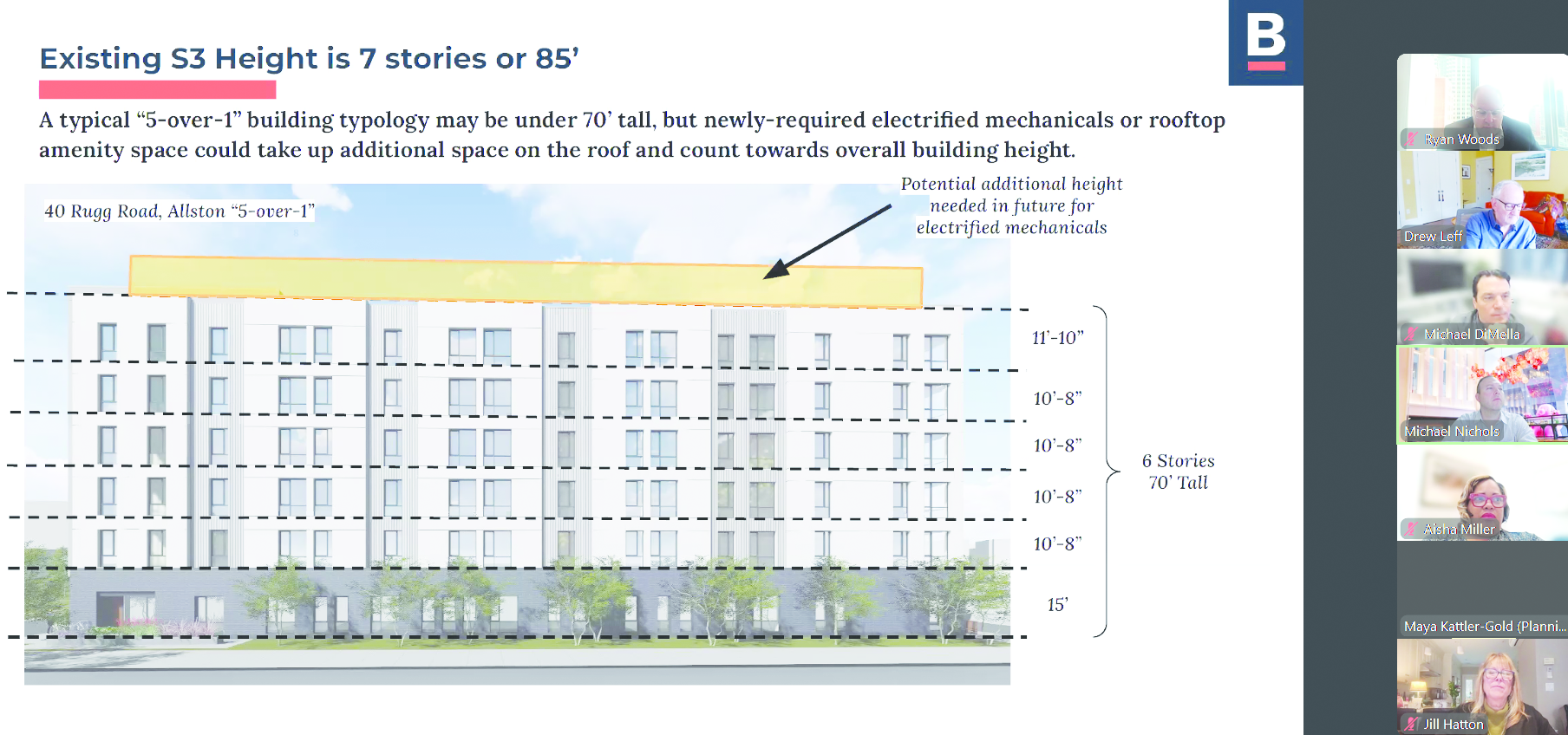
The existing S+S districts (S0-S5) increase from maximum allowed heights of four, to five, to seven, to about 12 stories in generally corresponding mixed-use proportions, and active ground-floor use is not required until the first seven-story zone (S3).
The new S3-6 zoning district differs from the original S3 (Active Main Street) district in only one way: it allows for a maximum of six stories instead of seven, thus connecting to the five-story S2 (Main Street Mixed-Use) district, which allows – but does not require – active use.

The new SC (Shopping and Commercial Nodes) district is similar to the S2 district, aside from allowing for a maximum height of four stories and more commercial uses on its upper floors. Its design also provides a link to the primarily residential four-story S1 (Main Street Living) district.
The Planning Department’s other S+S amendment – adopted in January and also a result of the citizens’ petition – expanded active uses on ground and upper floors (mainly in the S0-S2 districts) and made primary frontage ground-floor residential units in S2 a conditional use.
The hearing ran about 15 minutes and was uneventful, with public testimony in favor of the amendment from two members of the ad hoc committee (the only other testimony – also in support – was from District 5 City Councilor Enrique Pepén’s office), and a letter submitted by the Hyde Park Neighborhood Association (the organization most involved in the community-led response to S+S) that was also in support of the new zoning districts.
In short, there was consensus, but the whole process’ existence could be said to call into question the veracity of the S+S community process.
Those two amendments were adopted because residents put in the extra time, effort, and expense to prepare and follow up on a formal petition in order to try to force constructive communication with the Planning Department regarding their zoning concerns.
Beyond that, none of what happened between the ad hoc committee and the Planning Department to bring about those changes was public: the community at large was not officially notified of the proposed amendments until they were, in effect, ready for approval.
That noted, in early 2026, the S+S community process will resume when the Planning Department releases its proposed S+S zoning map for Cleary Square for public review.
For Squares + Streets information, visit www.bostonplans.org and scroll down to its quick link: https://www.bostonplans.org/planning-zoning/planning-initiatives/squares-streets
More in this section
First meeting of Jackson Square Neighborhood Association
Looking for ideas for 75 Amory
September 10, 2026
Fifth annual West Roxbury Art Walk starting this Saturday
Sidewalk sale and public art demos too
September 10, 2026
Comments