News
RL88 unwinds and resets in Hyde Park
Activists take stock of 2026
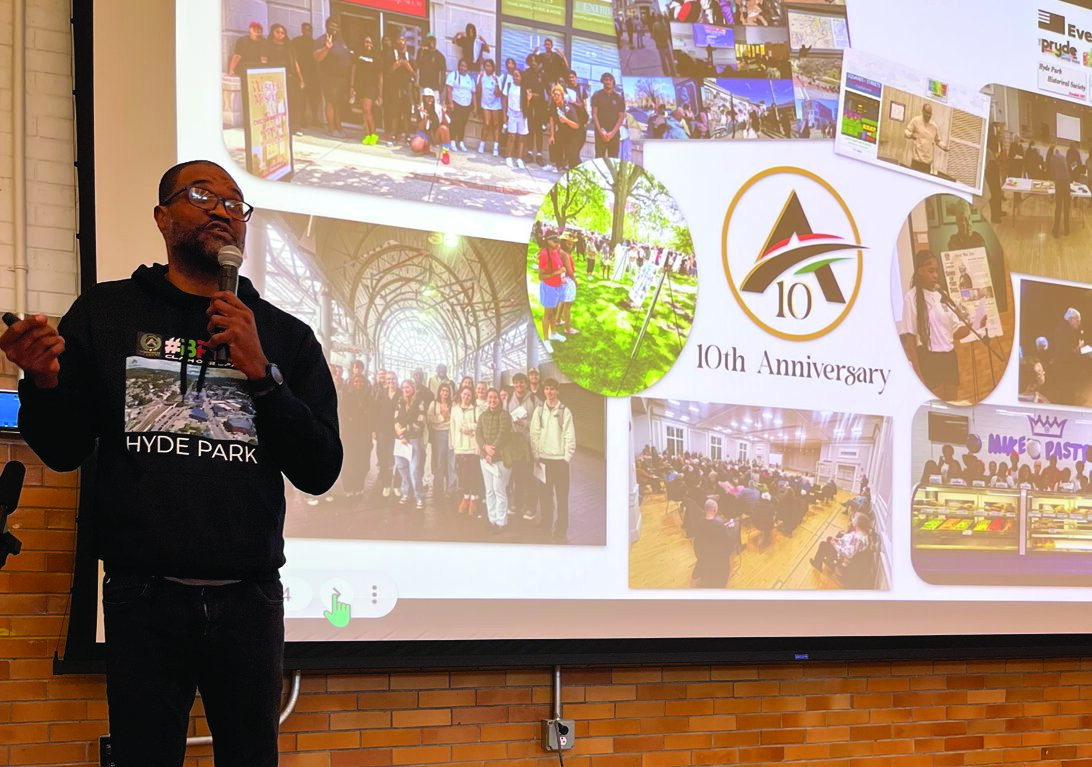
Being a community leader can be a thankless task, at least according to Marlon Solomon, founder and senior project engineer of Afrimerican Culture Initiative Inc, an organization meant to build up multicultural communities. Furthering his mission to include the public, he organized a gathering titled, “A Prepare and Repair Symposium” at the Pryde Community Center on Feb. 28, the last day of Black History Month. His approach was unique: relax first, learn afterwards.
As the title of the symposium suggests the participants “prepared” by receiving healing treatments from various businesses offering acupuncture to sound therapy; nourishing food came courtesy of a local Hyde Park eatery. Solomon said it was rare for community leaders to ever sit down and take care of themselves, so being an engineer who is used to maximizing spaces, his plan was for the people who normally dedicate themselves to caring for their communities to care for themselves. In addition to building up participants, he also highlighted small Black businesses by letting them offer their services free of charge while also promoting their businesses.
After everyone was sated and rested, Solomon took the stage and spoke about redlining in what he termed Boston Redline 88, referencing the number of years since the 1938 redlining map of Boston and 100 years of Black history month. Redlining started in 1938 as a way of cementing racial hierarchy through infrastructure, like highways cutting through communities, and zoning maps, marginalizing ethnic communities, especially Blacks. After the Civil War, Black people were on their way to create better lives for themselves but politicians of the time created laws and infrastructure designed to stop progress.
Solomon’s symposium, in its design, was a rebellion against even the formality of a typical meeting where participants can often feel trapped in a space, waiting for a host to lead the way. Certainly, he allowed, organization is necessary, but how people feel in those spaces is important, which is why as Solomon took the stage he asked if everyone felt restored. The audience cheered and clapped.
Solomon then called up one of his students from the nonprofit group Afrimerican Academy to speak about the contributions of Native Americans and African Americans, neither of whom asked to even be Americans.
“These two historic peoples have shaped the freedoms and democratic principles we in America benefit from today. Their history is not separate from America’s story. They are central to it.”
After the Civil War, Solomon said African American languages and culture were slowly erased, first through first slavery and then with “urban renewal”. And then Black people had to start fighting for their rights all over again under the guise of equality. He brought up an analogy of investing in Facebook at the start of its inception versus now: “It is two totally separate things.” His point being that when one receives their rights or investments matters.
Black History Month is in its 100th year, and Solomon emphasized its intention is to counter erasure which continues today.
“The people who erase our history work hard to erase our history. They do this because they’ve been successful. If Boston is about history, we cannot show our history,” he said. “Our spaces are gone. They hope you will forget. But we will never forget.”
Solomon is setting up an Equity Tour of formerly African American spaces aimed for this summer which he hopes will be ongoing.
Solomon shared a short documentary he created, “Claim Our Space” available on YouTube. Prior to Black History Month, Dr. Carter G. Woodson developed Negro History Week in 1926 as a way of protecting against erasure.
“It wasn’t really a celebration. It was more of a correction.” His initiatives are about exploring how to reclaim space through tours, films, workshops and dialogues.

For 10 years Solomon has been the founder of Afrimerican Academy dedicated to educating youth. His students will be the tour guides for the upcoming four or five Equity Tours in Boston, where African Americans once thrived: the North End, West End, Nubian Square, and areas of Mattapan and Dorchester. He gave special attention to one of his students whom he met when she was a freshman in high school and is now studying nursing at Simmons College, where “she is kicking butt and taking names.” She was instrumental in helping Solomon develop the Academy through her participation; she also started a podcast with other students called “Chat it Up.”
Samantha Benoit, site coordinator for the Academy, enthusiastically took the stage and almost danced with Solomon as she navigated the space talking about on-boarding staff and training youth for their work on the walking tours and encouraged people to go to sign up online at afrimericanone.org/tours for “The Once Upon a Time in Nubian Square,” which is a current tour. The Equity Tours are forthcoming. Solomon said he collaborated with several museums for these tours; thus partial funds generated by the tours will go back to the museums, in what he termed economic collaboration.
Collaboration was a big theme of the symposium and the businesses offering free spiritual healing said they were happy to participate, especially members of Small Steps. Based on teachings from Tolbert Small, a physician Black Panther, who learned acupuncture on a visit to China, the group hopes to integrate their practice into people’s health along with basic healthcare.
Dr. Angela Jamal said she often shows up to pop-up clinics where she is happy to help in these stressful times. Small Steps began during COVID-19 to help with vaccine hesitancy and evolved into what it is today, free holistic healing to marginalized places, according to clinical coordinator Jennifer Madu. From acupuncture to reiki to sound healing, the group partners with We Got US, a student-led Black empowerment group that hosts sessions and collects feedback from Small Steps identifying areas in most need. Participants eased into tilted rocking chairs while clinicians placed tiny needles in specific areas of the ear. Once finished they also placed little gold dots in those targeted spots, as the ear is known for having many useful pressure points to help reduce anxiety, stress and improve quality of sleep.
Edna Laurent sat proudly at her table with a client and now friend, LaVerne Merritt, a real estate agent. Laurent chastised her friend for only calling herself a real estate agent. “You need to do better to build yourself up,” she said. Merritt laughed and said it was something she needed to work on but praised the business Awake IntuMind for offering her “brain surgery without the surgery.” Merritt said everyone needs a wellness checkup in addition to a physical one.
She emphasized that Mass Health offers wellness checkups and people should take advantage. Laurent said she is solutions-focused, and she encourages her clients to focus on their strengths, even if it is something as simple as brushing teeth daily.
Solomon praised the sponsors of the event, including Embrace Boston, The Pryde, volunteer representatives of the 54th Regiment (an all Black regiment during the Civil War), Hyde Park Historical Society, Hyde Park Main Streets, and SouthWest Boston Community Development Corporation.
To get in touch with Solomon, email: msolomon@afrimericanone.org.
Comments