News
Shattuck redevelopment starts up again
Residents voice concerns
After eight years of planning, meetings and proposals, Governor Maura Healy put a halt to the redevelopment of the obsolete Shattuck Hospital last December.
Medical and psychiatric in-patient services now at the old 13-story hospital wing will be relocated to the West Newton pavilion at the South End in 2027.
In her announcement on Dec. 5 the Governor said that the Executive Office of Health and Human Services (EOHHS) and the Department of Capital Asset Management (DCAM) would be “launching a series of public listening sessions for a new request for proposals focused on supportive housing” in early 2026.
As promised on Feb. 18 EOHHS sent out a press release for a “Morton Street Redevelopment Listening Session” on Feb. 26.
“We want to hear from you in an interactive discussion.”
Not to be outdone, a consortium of CORES, The Franklin Park Defenders, and an unfamiliar group Boston In Common convened their own “listening session” for Feb. 18 to “envision better solutions … particularly for Black and Brown communities.”
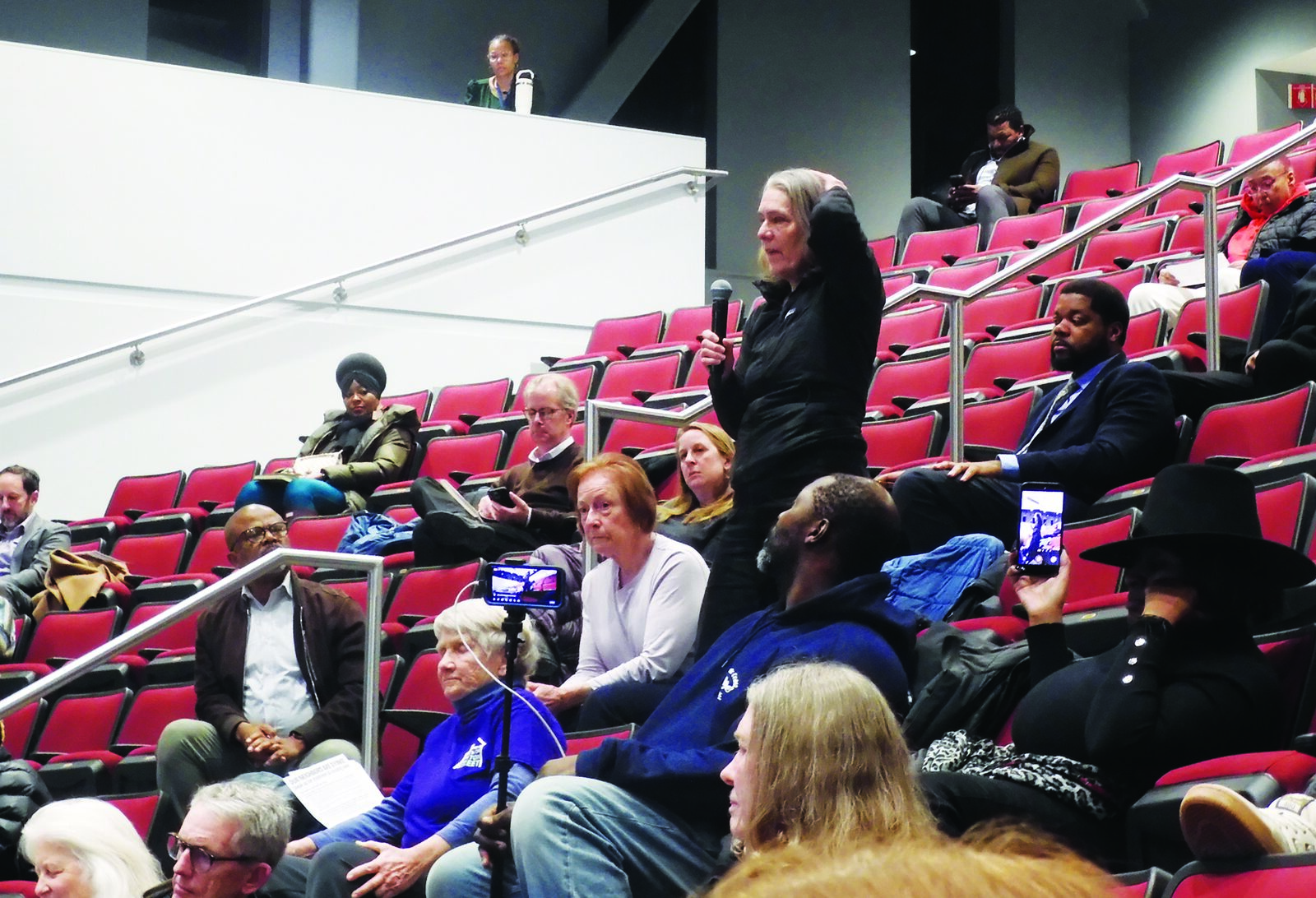
The two-hour meeting at a packed Lena Park Community Development Corporation Hall was moderated by former state senator Dianne Wilkerson and Emerald Necklace Conservancy (ENC) director Karen Mauney Brodeck.
The session had more venting than visions with a repeated emphasis on the allegation, as Pam Jones of Mattapan said, “Black and Brown people are being ignored.”
Franklin Park Defender Renee Stacey Welch set the tone immediately. “We’re not against supporting people.” she said,“we’re against warehousing people.”
“I’m really tired of [the state] keeping their knee on our neck. Black and Brown people are dying.”
In the audience were EOHHS chief of staff Chris Harding and EOHHS senior advisor Catherine Hornby; Hornby sent out the Feb. 26 announcement.
State Rep. Chris Worrell made a brief 10-minute appearance.
The CORES and Defenders contend, as they showed in a PowerPoint presentation, that “Franklin Park is under siege.”
They listed the Shattuck Redevelopment Plan, the professional soccer team at White Stadium, potential parking for Boston Legacy needs, media, EMS, etc. They also mentioned that the Park has become a “snow removal dumping ground.”
Wilkerson alleged that the golf course parking lot would be taken up for soccer games and that the “7th Day Adventists have been asked to leave their parking lot [at Humboldt Avenue].”
Harding was conciliatory.
“We have no preconceived notions,” he said, adding that Hornby would moderate the Feb. 26 HHS meeting. “If you have a solution we’re all ears; working together that’s why we’re here.”
“We’re starting from scratch,” Harding said. “The plan may be some combination of what came before: I was not part of that, but a lot of thought went into this.”
Wilkerson and Mauney Brodeck said they wanted a state-wide solution to the supportive housing plans, and a map was shown on the screen of what CORES/ Defenders said were the available sites.
What was not said was that the 13-acre hospital site should be returned back to Franklin Park, for which the ENC consistently and strongly advocated three years ago.
Speaker after speaker testified about what they did not want.
Defender Melissa Hamel’s remarks were typical of the crowd.
“We’re all caring people,” she said. “Look at a regional approach. Franklin Park is not the place for substance abuse people.”
The only person with a solution was Stenard Ross who said he lived in Mattapan and was a 30-year US Army veteran active in the Carter Post.
“What I’d like to see is a center for veterans,” he said.” We have a problem with drug use, with mental health issues. If you want to help us that would be great.”
It was déjà vu all over again when HHS senior advisor Catherine Hornby opened what was called the first listening session of the Moron Street redevelopment at the Brook High School on Feb. 26.
Admitting she was “relatively new to this,” Hornby added one important goal was to keep the Shattuck as a “public health campus for the state’s most vulnerable.”
“The process began eight years ago and was stalled because of feasibility,” she said.
With her on the stage were Deputy Commissioner of Public Health Hospitals Ted Constan and Josh Cuddy from the Office of Housing and Livable Communities. Cuddy has been involved with the Shattuck for the past four years.
Constan introduced no less than 10 senior staff from HHS who sat together in one row in the audience.
In a front row seat was State Sen. Liz Miranda who was not in office eight years ago.

“We are starting over,” she said. “We’re going to be here with you guys and listen very closely.”
“We are seeking input,” the PowerPoint flashed, “on this process and the future uses of this site.”
“We’ve heard quite a bit already,” Hornby said referring by name to the CORES group.
”Over and over we’ve heard supportive housing is important, just not concentrated.”
Opening the floor, Hornby asked “Does anyone have anything to say?”
Many people did, with over an hour of often emotional venting, allegations, speeches and reminiscences most falling into the “BUT” category:
“I support housing...”
“I worked in the Shattuck...”
“I have experience in public health...”
“I talked with drug users...”
“I worked with substance abusers...”
“ ...BUT just not in Franklin Park.”
Only one person stood up in favor of supportive housing and recovery services at the Shattuck, Sarah Horsely, who said she was with the Morton Street Coalition made up of 12 community groups.
“The need is urgent,” she said adding that “a lot more” would’ve been at the meeting but immigrants are afraid to go to public meetings.
Three solutions were offered.
Kevin Martone is CEO of Bay Cove Human Services. “We have been at the Shattuck as providers to substance abuse disorders since 2019,” he said.
Martone wanted Bay Cove to remain. “Its loss would be more homeless on the street,” he said. “Bay Cove wants safe and stable housing for our most vulnerable residents. It’s a stabilizing program.”
Jan Griffin is vice president of housing development at Pine Street. “Pine Street opened at the Shattuck shelter in 1983 in the old power plant building,” she said. “It’s a critically important asset for frail, vulnerable people. We believe housing is health care.”
Griffin suggested that a new shelter be built to replace the power plant building. “This is an ideal location for 150 unit supportive housing. Recovery services are really absolutely essential,” she said.
Stenard Ross returned to repeat his solution for veterans housing and services on the site. “We need a home for veterans,” he said. “They worked for you. Now you can work for them. We don’t have services.”
Dianne Wilkerson added with Ross that the Shattuck site could be a veterans center with urgent care and a “24/7 pharmacy.”
“This is the first of many listening sessions,” Hornby said adjourning the meeting. “Good night.”
People wanted to know when the next one was scheduled, but there was no answer.
Comments