News
Boston-owned grocery stores?
Council looks at food insecurity
The Boston City Council subcommittee on City Services, Innovation and Technology met last week to discuss methods of expanding affordable and healthy foods for Boston residents.
The discussion focused on a myriad of methods the City of Boston could utilize to help reduce food insecurity. Hearing sponsor and District 9 City Councilor Liz Breadon pointed out during her remarks some incongruities with current availability of food. First of all, she pointed to a food desert in Oak Square that require residents to travel far away just to have access to fresh produce.
She pointed to the mismatch of availability as well, as there is a senior living facility for low-income residents directly adjacent to Brighton’s Whole Foods, where those residents, most on a fixed-income or low-income, cannot afford to shop. There are food deserts across the city, but the Initiative for Competitive Inner Cities cites only two recognized food deserts; one in East Boston and one in West Roxbury.
West Roxbury has a glut of grocery stores, so some might find it hard to believe its official designation as a food desert, but there are areas of the neighborhood that are not within one mile of a supermarket, making it difficult for residents without a car to access fresh food and produce.
Affordability was also a key concern. Breadon said many seniors are asking for a shuttle bus to Waltham to access the lower prices at Market Basket. She added some residents have told her they save about $100 a week driving to Somerville for groceries – which, in essence, makes it more expensive to be poor – https://en.wikipedia.org/wiki/Boots_theory
The council discussed with Boston Director of Food Justice Aliza Wasserman the idea of city-owned grocery stores in key neighborhoods to supplement food access for residents. Specifically, she was asked about several other cities’ recent efforts towards these kinds of stores, which so far have amounted to feasibility studies. Wasserman was decidedly unspecific, even about a study.
“I think I would need to learn more about how that type of model would work to understand if there are advantages and what they would be,” she said.
There is the broad model that New York City Mayor Elect Zorhan Mamdani has proposed in a pilot program. In this program the city owns the stores. The pilot he proposed would start with one store in each of the city’s five boroughs.
That’s the current headline grabber at the moment, but there are dozens of other municipality-owned or supported models across the globe. In the United States, these models have proven difficult, with many cities already experimenting with the idea finding it too expensive to maintain or even break even – https://en.wikipedia.org/wiki/Public_grocery_store
Indeed, Wasserman pointed out that because the profit margins are so thin in the grocery business, it usually takes about 10 years for a store or chain to either break even or figure out if doing so would ever be possible.
“It is a very difficult business, and then when you add a really well-aligned Office of Food Justice mission on top of the challenges of running a business like that, I think that these are really technical challenges for us to continue exploring,” she said.

However, according to reporting from The American Prospect, market consolidation and the negotiating power of huge retail chains like Wal-Mart has led to independent markets being simply unable to compete – https://tinyurl.com/yc8kfsw9 – and that many such chains are operating as de facto monopolies, destroying any chance for competition.
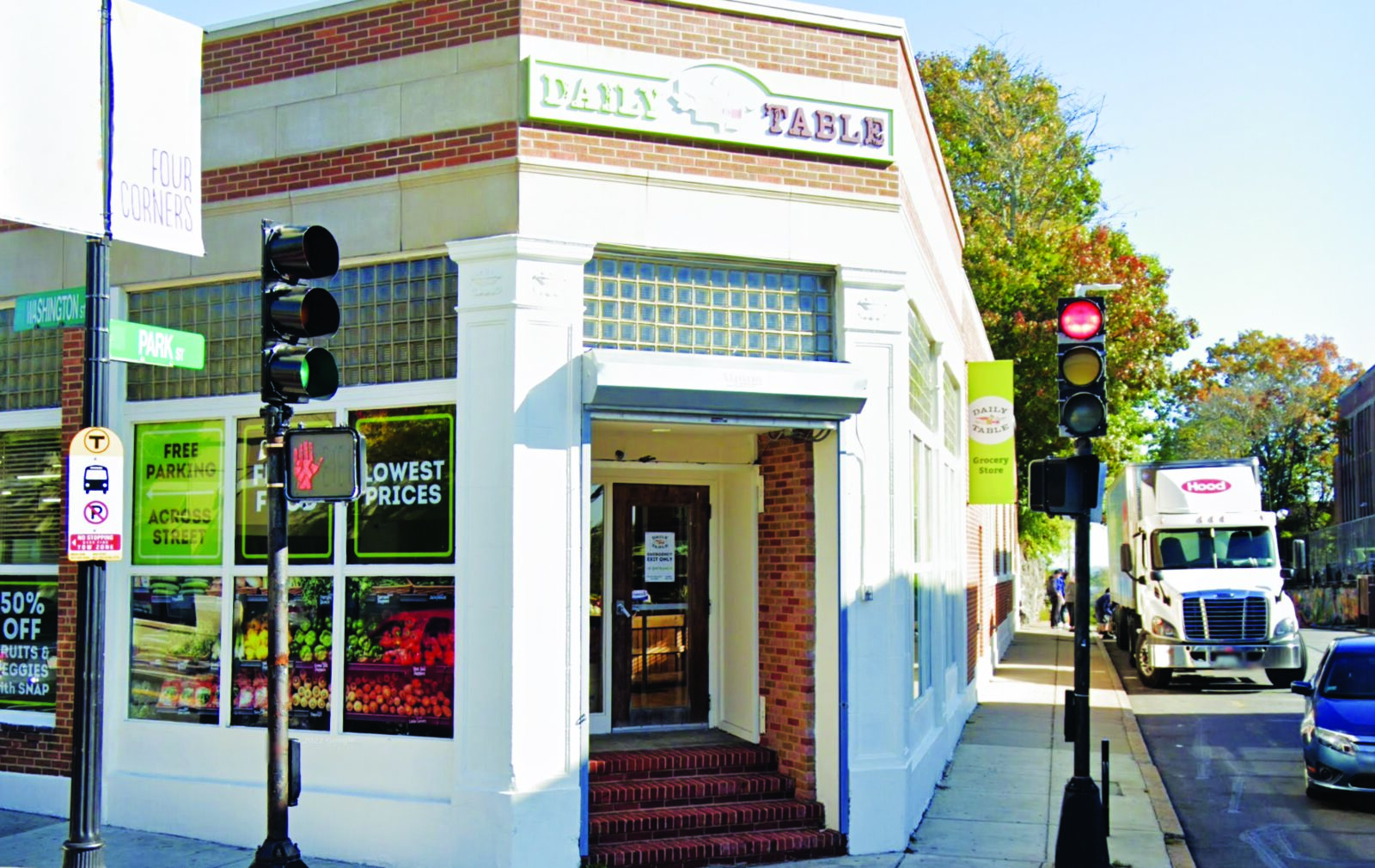
City Council President Ruthzee Louijeune and other councilors asked about possibly investing in currently-operating independent grocery stores, like the Dorchester Food Co-op for instance. Wasserman said it is an option the city should look at. However, at another time in the meeting the conversation drifted to the Daily Table, a five-location nonprofit chain that operated from 2015 to May of this year. The city put in $100,000 for capital costs. Even with that investment, its nonprofit status, and the grants that can come with that status, the Daily Table had to shut its doors.
Louijeune pointed out a small ray of hope in that the biggest operational costs for a grocery store is generally rent, for which the city could waive if it used one of its own buildings.
Another small ray of hope, brought up by Boston Director of Policy, Economic Opportunity and Inclusion Elijah Miller was Squares + Streets (S+S). He said the loosening of regulatory hurdles around zoning will likely make it easier for grocery stores to open, reducing that recouping time of 10 years mentioned above (hopefully).
“We might find with the S+S initiative that simply reducing regulatory burdens and enabling private operators to thrive would be successful at making food accessible for residents, and there is a history of that going decades into the past in Boston and is an outcome I think we can expect from S+S and Plan Downtown,” he said.
Both Miller and Wasserman said that if there is going to be any nudging of the needle up the food chain in terms of pricing, the purchasing power needed to do that would require region-wide collaboration, meaning other states in New England and beyond would likely have to join forces to go up against the conglomerates that control much of the supply chain around food in the United States.
“There is some work happening around that nationally,” Wasserman said.
The three-hour meeting discussed many more topics that could not be covered here. Go to https://tinyurl.com/bddr3nrn to see the whole meeting.
About the author
Jeff Sullivan Covers local news and community stories.
More in this section
E-5 District needs community engagement to help fight crime
Residents are E-5’s eyes and ears
October 22, 2026
Three housing applications pass easy at ERNA
Yet Ross Field disturbances still an issue
October 22, 2026
Comments