News
Council talks eliminating parking minimums
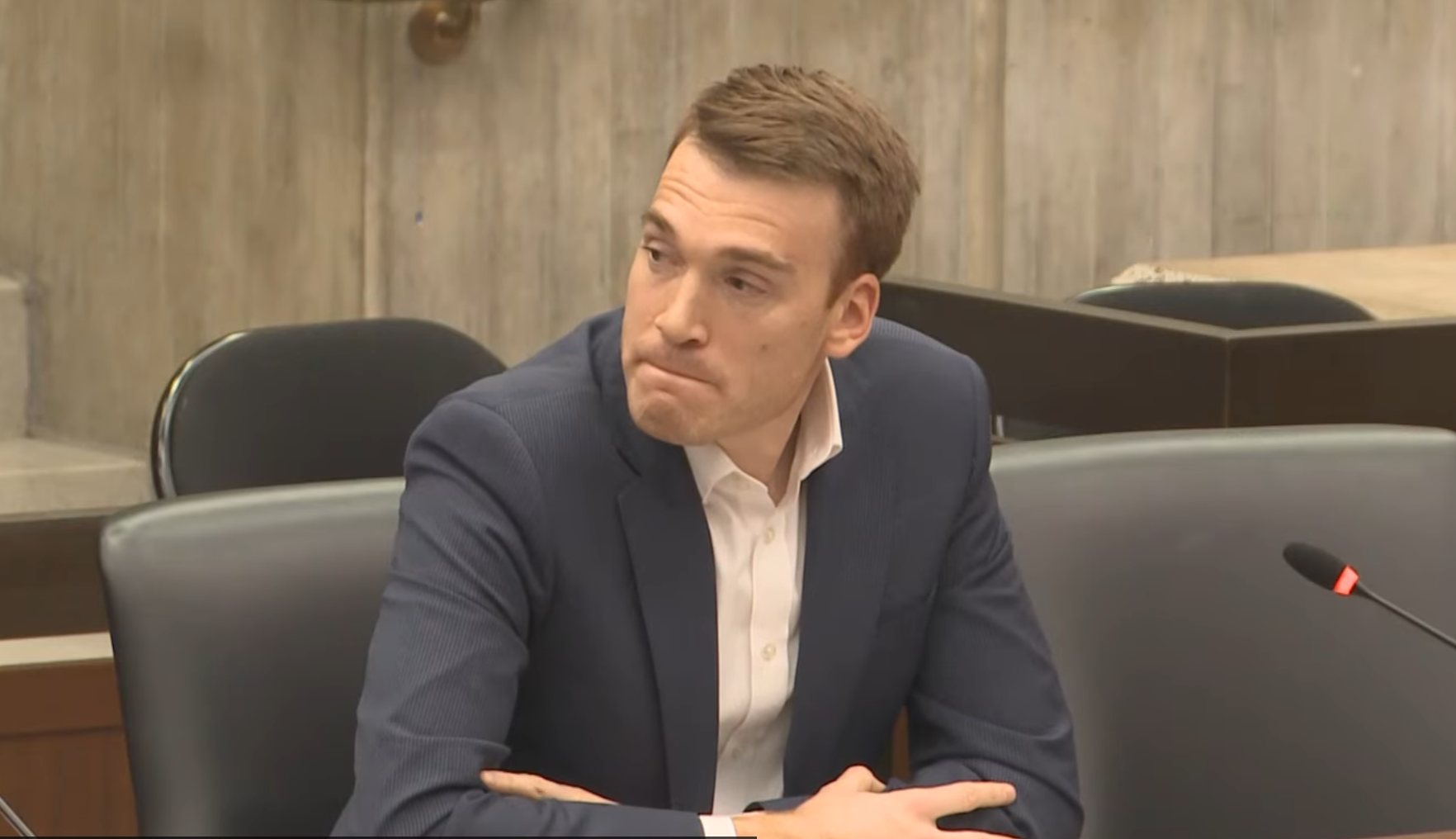
Last week, the Boston City Council voted unanimously to continue a hearing on eliminating parking minimums in new development in The City of Boston.
Hearing sponsor and District 8 City Councilor Sharon Durkan brought the matter for a vote on Dec. 10 that passed after a hearing was held the day before. She said the issue came up because parking minimums in the city are impeding development and home construction, which is in turn adding to the city’s current housing and affordability crisis.
The argument is basically that parking requirements are outdated and unnecessarily increase costs of building new housing, which is passed on to the homeowner or renter.
During the vote, Durkan pointed out that an above-ground parking space can cost as much as $50,000 each, and an underground space can be as high as $150,000 to build within a project.
The hearing went over a wide range of topics, but from the Mayor’s Administration side of the discussion, Deputy Director of Zoning Devin Quirk said the plan on Wu’s side right now is to continue to work on the issue district by district.
“We’re very interested in this, and we will follow this very closely, but our current position is not to eliminate parking minimums citywide, all at once, it is to work district-by-district,” he said.
Quirk pointed out that in certain areas the city is already eliminating parking minimums in district-by-district efforts like Squares + Streets (S+S), but he pointed out without addressing the zoning in each specific area first, eliminating parking minimums all at once could have negative repercussions. He said, for instance, that S+S is looking to eliminate parking minimums, but that zoning effort is sited in main streets with high instances of public transportation and can afford to perhaps not have any parking.
He also said that parking will not disappear as a zoning consideration either and pointed out that if the project is over 20,000 square feet the Boston Planning and Development Agency (BPDA) Board would have jurisdiction to dictate parking; if it’s lower, then the Boston Building Commissioner would have authority to require spaces.
“But at the end of the day, there may be no parking,” he said. “If there are no other zoning variances needed and we’ve eliminated parking minimums, then a development can move forward without any parking.”
And so Deputy Director for Planning review James Fitzgerald pointed out that simply lowering parking minimums could have the benefit without the potential for projects going in with no parking where they could cause problems.
However, Durkan said she felt the conversations around parking minimums have been moving too slow. The Boston Planning Department in the past – when it was the BPDA – did in fact reduce many parking minimums throughout many different neighborhoods, but as Fitzgerald pointed out, some neighborhoods still have two spots required for every unit of housing built.
Abundant Housing MA Executive Director Kanson-Benanav gave a presentation on support throughout the city for eliminating parking minimums. In one slide – https://tinyurl.com/48vkmcaw – he showed a clear majority of residents in each of the city’s neighborhoods at least somewhat support the city changing rules to “allow property owners to determine the size and location of paved parking for new homes.”

Parking Reform Network representative Daniel Herriges also gave a presentation that showed more than 100 cities of varying sizes across the country have eliminated such parking minimums from their zoning codes, and he discussed some of the opposing arguments he’s seen or heard.
“Because we’ve seen this reform taken up so many places, we don’t have to get stuck on a ‘what-if’ if something goes wrong with this,” he said. “’What if somebody can’t find enough parking?’ The what-ifs are often very salient, but I think we have a status quo bias because the housing that isn’t built doesn’t exist. So the what-ifs are really to easy to conceive of, but we do have data as to what happens. And the first thing that happens, is nothing.”
He said that’s at least at first, but over time, the market adjusts to the flexibility and people start to use housing that doesn’t have parking. He pointed to a recent graph from Minneapolis showing how eliminating parking minimums affected the number parking spaces per unit on new construction – https://tinyurl.com/yeyn8w7b
“And you see that parking hasn’t gone away, but that bell curve has shifted so that the average ratio (of parking spaces to units) is now about 70 percent of what it was,” he said.
Most of the residents who testified at the hearing were in support of the measure. However, Mount Hope Canterbury Co Chair Rick Yoder testified that parking-less developments in the neighborhood – which borders Roslindale, Mattapan and Hyde Park – would lead to more cars on the street, as there are few amenities and very little public transportation.
“To get to any of those amenities, it’s 1.5 miles, maybe 4.5 miles in some cases,” he said. “The only reliable public transportation for us into Boston are the 32 Bus and the Orange Line. So if your life is in Downtown Boston, you’re good to go, but for most of us, it is not, they travel all over the city. We have construction workers and people with kids where parents have to take them everywhere all the time, and of course there is shopping. Shopping means going out of our neighborhood. I can’t support this as expressed because it’s for all development. It has to be nuanced and depend on the situation.”
During the regular city council meeting before the vote to continue the hearing, Durkan pointed out that much of the current built environment in the city predates zoning and parking minimums.
“There is a lot of confusion and misunderstanding surrounding this issue,” she said. “This conversation is about eliminating costly parking mandates that force developers to put in parking even when it is not needed, which increases rents and home prices for Boston residents. This reform does not eliminate parking; it simply removes arbitrary barriers in the development process that slow down housing production and provides the flexibility to build what makes most sense for each project in each neighborhood.”
About the author
Jeff Sullivan Covers local news and community stories.
More in this section
First meeting of Jackson Square Neighborhood Association
Looking for ideas for 75 Amory
September 10, 2026
Fifth annual West Roxbury Art Walk starting this Saturday
Sidewalk sale and public art demos too
September 10, 2026
Comments