News
WRHS hosting trivia and tours for neighborhood’s 175th birthday
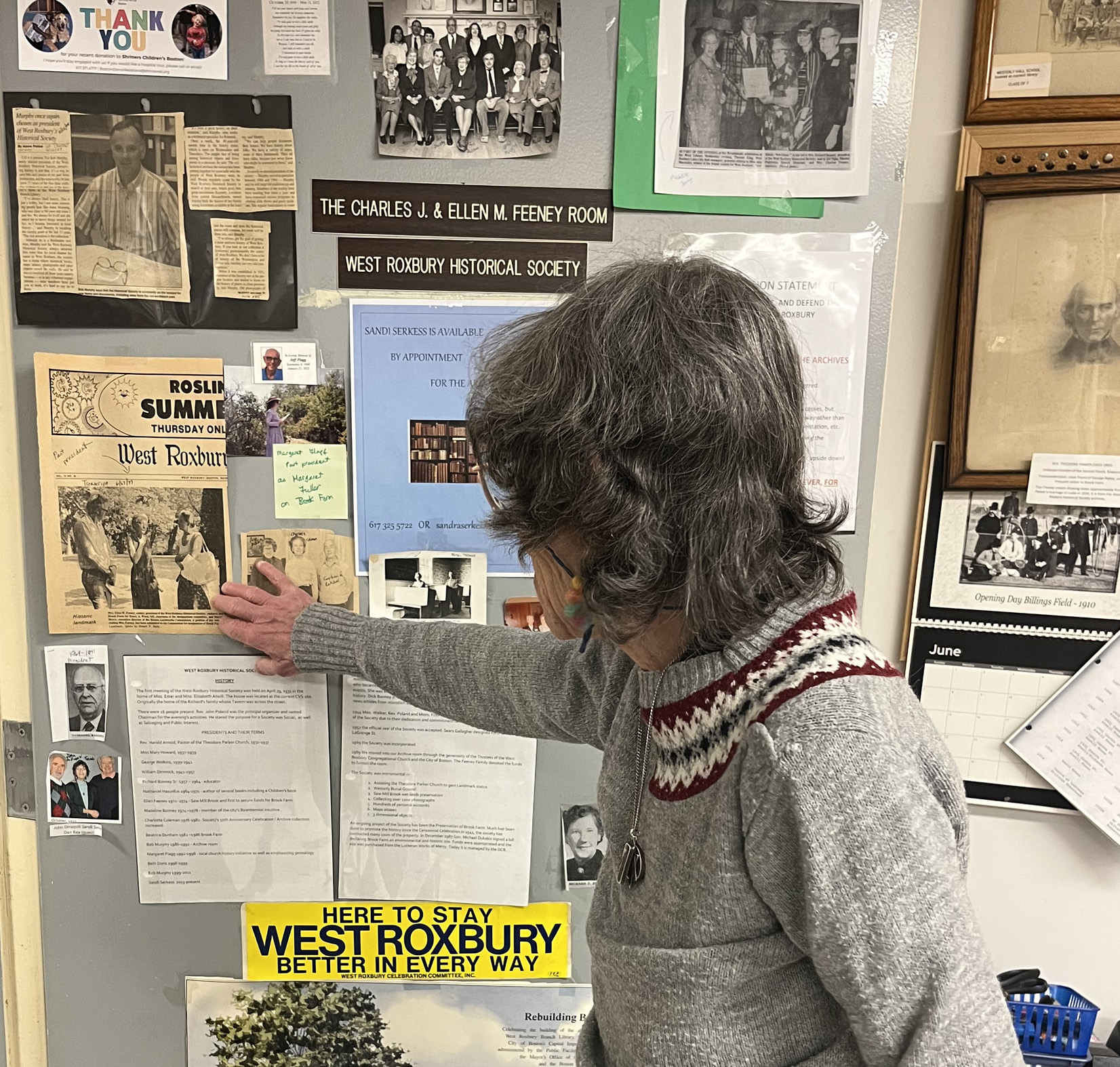
Something most people have trouble grasping is the fact that historical figures were real people, not just their accomplishments and time in history.
People file away facts dutifully without really considering what life was like in the 1800s or even the 1950s. Sandra “Sandi” Serkess, the president and sole member of the West Roxbury Historical Society (WRHS), has spent countless hours poring over historical diaries, town records and old newspapers and on occasion made phone calls to those once in history books. In addition to appreciating the humanity of historical figures, she shares her wealth of knowledge through lectures at the West Roxbury branch of the Boston Public Library (BPL), and now that West Roxbury is in its 175th year she has many events lined up from a trivia night to a few walking tours of significant locations like the Bellevue Water Tower at Bellevue Hill and the Westerly Burying Ground on Centre Street.
If you want to get a sense of it yourself, Serkess will hold a lecture titled, “Why is it West Roxbury’s Birthday?” on March 28 at the West Roxbury branch of the library. West Roxbury trivia will be held June 5, “under the stars.” Walking tours will be held later in the summer of the water tower, Centre Street and a special tour of Westerly Burial Ground, by Boston Parks & Recreation employee Kelly Thomas. In addition, Serkess is holding an ongoing slogan contest for residents to express their feelings toward their hometown. More details to come as we march out of the snow and into lighter weather.
For Serkess’ part, she said she prides herself on reminding visitors that these figures of note who lent their names to Billings Field, the Draper School or Centre Street were real people. Now in its 95th year, WRHS had no home for the first 50 years, Serkess said. Various basements served as storage for the myriad of town records, diaries and maps, currently housed in its permanent home in an office on the first floor of the library.
The files have original documents going back to the 1600s. But some items need to be donated to bigger organizations, as they need to be temperature controlled. For example, a fire bucket from 1769, donated by Serkess’ piano teacher, began to fall apart. To repair it would have cost roughly $25,000 so she had to gift it to the Boston Fire Museum.
Serkess said she loves her office which might look old-fashioned, with coffee cans serving as storage, but she said it is highly organized. She said she knows exactly where everything is and has plenty of post-it notes with names like Brooks Farms and many pictures of various residents of West Roxbury mostly from the 1800s when photography began.
They house maps which Serkess admittedly does not know how to interpret but she refers her questions on them to a volunteer within the library who is an expert on maps. Serkess went throughout the small office dropping many factoids, including that Jamaica Plain used to the be the capital of West Roxbury before it eventually seceded. She mentioned the Soldiers Monument in JP, which for some might just be a location to pick up the 38 bus.
Serkess said she has logged in many hours since she began at the society in 1990 but credits the people before her for laying out a path. The founder of the WRHS was Rev. John Poland who started it in 1931, but Serkess says he was more of a researcher. Prominent presidents of the society are Ellen and Charles Feeney who donated much of the furniture, and the most recent president was Bob Murphy, who retired in 2010. After that, the office closed down for five years as Serkess was busy raising her son, but she returned ready to work in 2015. Among the many pictures of past presidents was a sign in yellow reading “Here to Stay in West Roxbury,” which encapsulates Serkess’ point of view.

Serkess moved to West Roxbury with her family in the 1950s and relishes her memories of hanging out at Billings Field and playing with all the neighborhood children on her street where trust was a given and no one locked their doors and sometimes didn’t use doorbells. She recalled fondly asking a neighbor for money to fulfill a dentist’s prescription and the neighbor told her not to pay him back – which her father immediately did – but she lamented the times have changed where people are not as trusting or sociable. “We are going to have to work hard to hold onto ideals,” Serkess said.
“West Roxbury residents are intelligent and hardworking stock,” she said. She smiled and added that there are not too many bars or clubs, and instead West Roxbury is about neighborhoods, schools and raising children. Religion is also big. Serkess delighted in saying that West Roxbury residents are interested in books, as well as The Book. And the way Serkess was brought into the West Roxbury Historical Society was by way of her Jewish faith. She often wears a necklace, given to her by her brother who passed in 1989, with whom she was extremely close, and is a symbol of her faith. A brazen person at a community meeting walked right up to Serkess and asked if she was Jewish and then wanted her to provide a history of the Temple Hillel B’nai Torah, on Corey Street. Taken aback, Serkess was also intrigued as she is passionate about her faith and educating others. In the 1950s through the 1970s, the temple was Temple Beth Torah but then it merged with Temple Hillel to become what it is today. The somewhat forthright person also helped Serkess learn the art of historical research and from there she caught the attention of those atthe historical society.
Serkess stressed that several churches ranging from Arabic, Syrian, to Catholic thrive in West Roxbury. Alongside the many churches are at least 10 banks and she is not sure what to make of that other than West Roxbury is just a desirable place to live. Outside of some brief stints living in Allston, MA and Rome, Italy, she said she loves being in West Roxbury, nestled in her home, which is conveniently near the library.
West Roxbury feels like the suburbs, she said.“With no manufacturing, the air is clearer. Trees are everywhere and clean the air like vacuums.”
Historically, West Roxbury has always been safe; due to the rugged rocky landscape, Native Americans only visited West Roxbury in the summer. During the Revolution and Civil War, battles were in Dorchester and Roxbury, not West Roxbury. Serkess has read many diaries including one by a teacher, Hannah Richards, during the Civil War.
Serkess encourages anyone interested in diving into West Roxbury’s history to email her at sandraserkess17@gmail.com or call the West Roxbury branch library to schedule an appointment because while she works out of the library she does not work for the library and is not always in her office.
Comments