News
West Roxbury was pretty peaceful
WR Hist. Society details peaceful past of the neighborhood
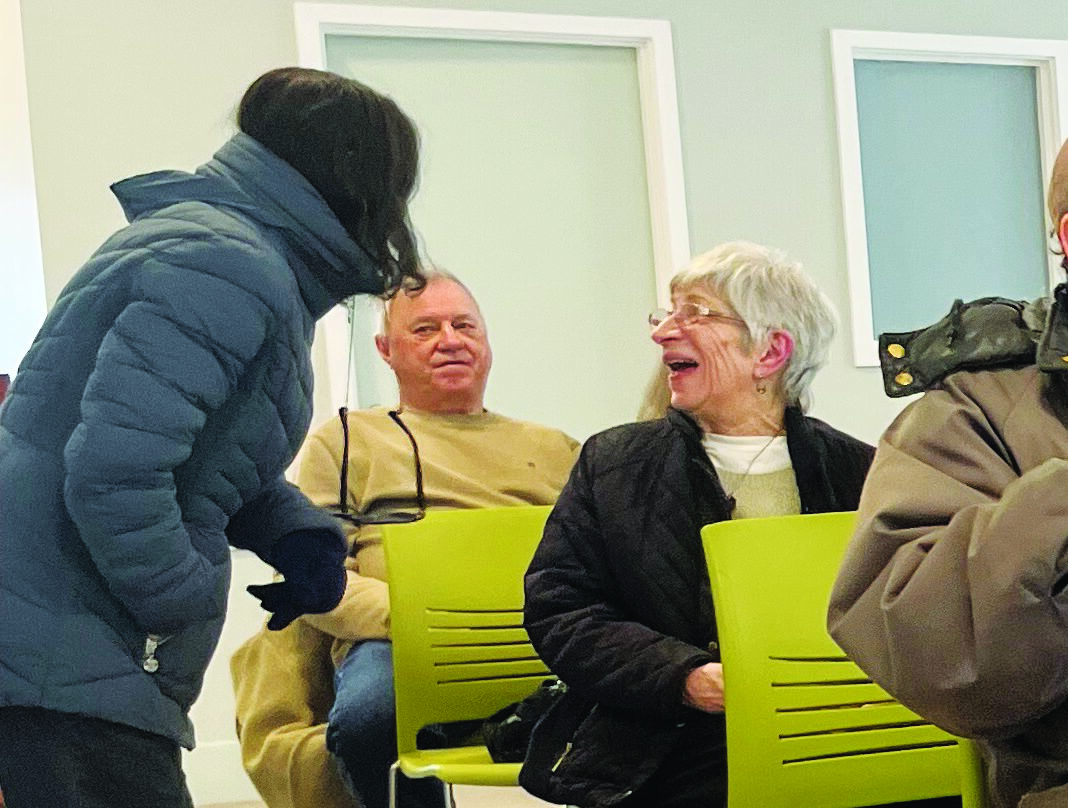
On a crisp windy spring day, about 50 people huddled inside the warm lecture room of the West Roxbury branch of the Boston Public Library to listen to a history of the neighborhood from West Roxbury Historical Society (WRHS) President Sandra Serkess.
While it might have felt more like an intimate one-sided conversation on West Roxbury’s origin story, it was also a reminder that this is West Roxbury’s 175th birthday where many fun upcoming events will take place throughout the year. From walking tours to trivia nights to a slogan contest, there is a big slate of events coming together which can be found at https://gvimes.link/wr175
Serkess gave a special shout out to Roche Brothers for providing gift card prizes for the winners of the contest.
Prior to the talk, Serkess reminded the crowd that the historical society is a volunteer group and as such requires funding, jokingly referring to her “glorious donation jar.” This yearly lecture is one of the ways the organization raises funds to help its mission of preserving West Roxbury history.
Serkess started off by taking the crowd to millions of years ago when volcanoes dominated the land, to the ice age to the meltdown that left behind mostly rocks which led to the name. Those glacial deposits led to the name of neighborhood: Roxbury.
By the early 1600s, when the Pilgrims and Puritans came over, they were on land not built for farming. In fact Native Americans only came by during the summer for fishing and shellfishing and left by the fall and thus no conflicts took place as there was not much to fight over, Serkess said. One of the earliest settlers were the Puritans, led by John Winthrop. Serkess described these people as insufferable perfectionists who were almost opposite to more humane Pilgrims. She then showed a 1632 map of Boston which she admitted she is not very comfortable with and referred all map questions to a volunteer at the library. William Pynchon and his wife were responsible for the settlement of Roxbury and he served as a treasurer. In those days, mainly churches served as local government and people would pay tithes as a form of taxation.
Due to the geological history from volcanoes and ice, the soil was very rocky and springs were abundant, thus the name Spring Street. West Roxbury took a longer time than the rest of Boston to get settled because of this. Serkess said drumlins (high points) and low points were very common. The water tower on Bellevue Hill is one of the highest points in Boston and then she referred to Billings Field (near the Parkway YMCA), a low point. One could not make a living as a farmer, although people did farming for their families. Having a large plot of land was a given as one needed chickens, cows and barns for survival.
While the poor quality of land made agriculture difficult, it made for a peaceful place to live, Serkess said.
“Every night you could go to sleep knowing you wouldn’t be attacked in bed.” She also cleared up why West Roxbury was known as Upper Roxbury, despite being in the southwest. The “upper” simply referred to the hills.
Serkess credited the Weld family for settling West Roxbury and referred to some well-known Welds including former governor William Weld and actress Tuesday Weld who are cousins. Joseph Weld was the one who settled West Roxbury by negotiation with the Native Americans after much fighting; his brother Daniel was a teacher at Roxbury Latin. Many of his family made contributions toward the settling of West Roxbury and the expansion of its community. The Welds played a significant role in the Arnold Arboretum. The prominent Welds are the descendants of Joseph Weld.
Describing with affection William Blackstone, Serkess spoke of another type of personality altogether who had no ambitions of expansions or making a name for himself. A minister from England, Blackstone sought solitude and peace among cows and sheep. And so he enjoyed this for a time until the Puritans came in on all their ships. This drove Blackstone to ship out, Serkess said, chuckling.

Serkess weaved in and out of different time periods to a rapt crowd who had many questions for her in the end. Ralph McCarthy, a longtime resident of West Roxbury said he loved the lecture and found Serkess fascinating and even presented her with a letter from the historical society to his grandmother from 1976 which Serkess read with interest. He said he can’t wait to attend more lectures detailing facts about his hometown.
Serkess brought up how immigration influenced the town with more cultures and people competing to establish themselves. The invention of the steam engine and subsequent locomotives was a game-changer for West Roxbury and made it more accessible to immigrants who could have a day job and travel to and from the city into West Roxbury. Also since not many people resided in West Roxbury, competition was low.
Serkess showed pictures of Mother Brook in Dedham and the Billings’ house. She said the pictures of the family were incredible and the people felt approachable. One of the Billings married someone from the Dana family, who she described as influential and the namesake of Dana Farber.
Another prominent family, the Drapers, who apparently had two branches, contributed greatly to the community and were the first to be buried in Westerly Burial Ground, a place for a walking tour this summer. The other side of the Draper family loaned their house to the war efforts. After the American Revolution, many lost their fortunes as no one got paid during war time; it was simply a duty.
Serkess then described how for a time West Roxbury gained independence from Boston and the population doubled. What they needed was schools, as West Roxbury has always prioritized education, and so residents built them themselves, with each person contributing resources. She described the difficult realities of fire stations of the time and how they either needed to go slow to avoid hitting children but as a result would miss putting out the fire.
“Everything was experiment,” she said. Centre Street needed to be widened, and she describes this street as the main source of business in West Roxbury.
When West Roxbury returned to Boston as a way to preserve the town’s character and “avoid exploitation from certain officials,” West Roxbury became one of the biggest voting blocs. But today, only 20 percent vote, Serkess said. “Even if you hate all the candidates, write in Mickey Mouse. Voting is a privilege.”
Serkess is openly passionate about West Roxbury and her decision to be a lifelong resident. For those with questions on the town or on upcoming event during this 175th anniversary, Serkess encouraged people to email her at sandraserkess17@gmail.com.
Comments