News
Roath explains why he is better candidate than Lynch in Congress
EDITOR'S NOTE: An earlier version of this story stated that Roath grew up Braintree. Roath grew up in Connecticut, but his mother grew up in Braintree. We apologize for the error.
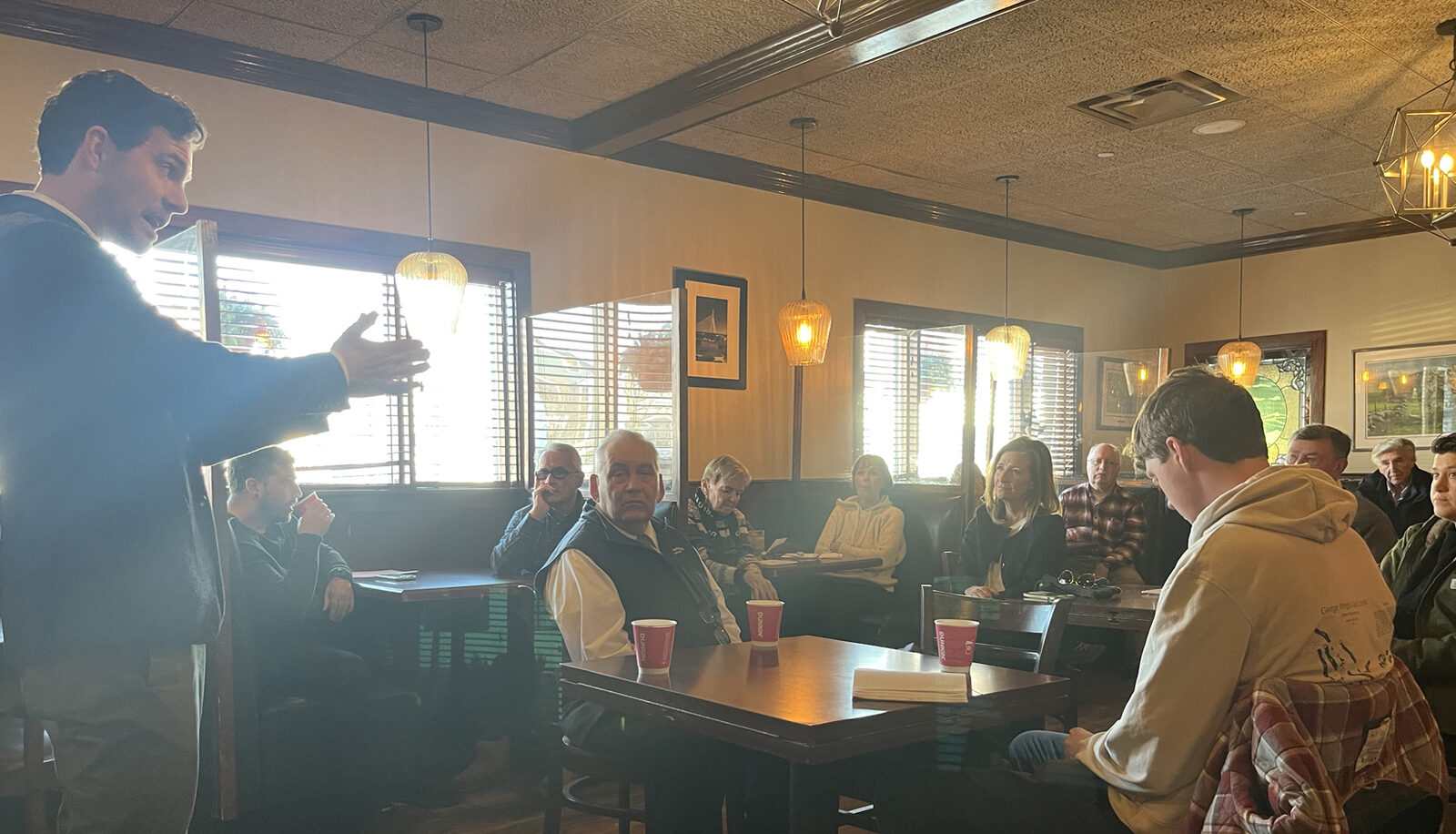
Candidate for the 8th Congressional District Patrick Roath made a pitch for why he was the politician crucial to this specific time in history, at the monthly West Roxbury Business Professional Association (WRBPA) meeting, on Feb. 11. Nobody needs an explanation on how democracy is under threat in this current administration; they can just keep doomscrolling. Roath brought up specific points on why he is the better candidate to effect change and also said in reference to his opponent, Stephen Lynch, that he believes in term limits. Lynch has served since 2001.
Roath began his speech saying he was on three hours of sleep due to his 8-week-old daughter, Simone. After that, he launched into his bid for becoming a representative in Congress. “More than anything this campaign is about what we are going through as a country right now. It is a really scary time. There is a threat from the White House threatening our way of life, our democracy in a way that is different from what we have seen before.”
Roath grew up in Connecticut, and said his parents met while working at IBM in MAssachusetts, a company they both stayed with for 30-plus years enjoying middle class prosperity. Roath said he chose to share that as he feels that type of story is less common as the American Dream, even feeling unattainable for many.
From the age of high school, Roath said he was political, protesting the war in Iraq. Later in college, he worked for former Governor Deval Patrick and afterwards he spent time at the White House under Barack Obama. For the past 10 years, Roath has worked as a lawyer in private practice and also is aligned with Common Cause Massachusetts, a non partisan group that focuses on voting rights, democracy and reform, and helps with things like mail-in ballots and automatic voter registration.
“We have got to rebuild confidence in our democracy,” he said. “It’s not just about saying Trump is bad. Of course, Trump is bad, but it’s about providing an affirmative, optimistic vision like Deval Patrick did, like Obama did.” Affordable housing is a fundamental issue for Roath, and he wants to develop ways to help people make their first down payment and incentivize people to stay in communities.
A secondary issue is childcare, which he joked was a little selfish of him to say as he is a new father. Childcare centers average $25,000 a year in Massachusetts, and Democrats in Congress have the potential to help families cover those expenses, he said. Healthcare and education also are up on the list and if Democrats had their politics “right” they could get down to nuts and bolts issues. What sets Roath apart from many politicians is that he said he does not receive corporate PAC money. He values the separation of politics and corporations and lives up to his ideals. The combination of campaign financing and “the structures” created make it easy for politicians to become passive. “I think it’s time to have term limits, to make it easier to get new people into the system.”
Roath said he does not see the leadership from Lynch on the important topics of housing, healthcare, childcare and education. He spelled out that Lynch does not listen to communities the way he did earlier in his career, and that he has not had an in-person town hall meeting since 2019. (Lynch did have a virtual town hall meeting March 2025). Of the decisions Lynch has made, like voting no on the Affordable Care Act, Roath is in disagreement; he also disagrees with Lynch voting with Republicans on the Laken Riley Act, which causes immediate incarceration for immigrants accused of crimes. He called that bill short-sighted and said it did not help curb crimes of immigrants but instead terrorized communities.
The first question that followed dealt with Roath potentially being a socialist, to which Roath said no. Prior to the question portion of the meeting, WRPBA President Jim Hennigan advised members to actually ask questions and not deliver long commentaries. The member challenged Roath on his response by saying his desire for universal healthcare suggests otherwise. Roath said that wanting optional solutions is not socialized medicine; it is simply smarter to make sure everyone is able to receive basic healthcare because if not it causes problems down the road. When asked if Boston city employees would be allowed to stay on their own health insurance plans, Roath said yes. He is not interested in stripping away private insurances; instead he said wants to expand options for those who need it.

Joe Donnelly, who work in real estate, asked for Lynch’s net worth when he started in office to now. Roath laughed and said he appreciated the question but does not know. Roath then switched gears to the main question which he felt everyone wanted to ask: how does he expect to beat Lynch, an incumbent of 25 years. His campaign manager interjected and said to add something positive, but Roath said he wanted to address the difficult question. He said his message is one that people are excited about, and people have “an appetite for change.” Roath has been a full-time candidate since last May and the primaries are in September, so that is a long way. He has already raised more money than Lynch without PAC support, which Roath is very proud of.
Another question dealt with how to raise incomes or reduce debts. “We have to get our fiscal house in order,” Roath said. First, the economy needs to grow in order to get more tax revenue. If people’s basic needs are met they will be able to invest more in the economy, making it grow. He said this in regard to his agenda of supporting social programs. Roath would ask the people making the most money to pay the most in taxes, and stop using loopholes to avoid paying taxes.
“It’s a serious challenge. I’m aware of it.”
Billionaires are not the only ones Roath would tax more. Universities and hospitals should be taxed more fairly too, he said, and the idea of a distinction between profit and non-profit was a fiction. He used Harvard University as an example of a non-profit with a lot of wealth.
In response to a question on rent control, Roath said the main answer is supply in areas that are accessible to big economic areas. Rent control can make sense but it is just one option.
Roath said if anyone is interested in volunteering or asking him questions to reach out to him. His email is patrick@patrickroath.com.
More in this section
Union says Allston Post Office loss = intentional privatization
Advocates say USPS actively trying to shut down post offices
October 1, 2026
JPHC: Change it after approval
JP Housing Committee wants changes to 3841 Washington Street already approved by the BPDA
October 1, 2026
Comments
Patrick Roath did not grow up in Braintree! He didn't even grow up in Massachusetts. He was raised in New Canaan Connecticut, one of the most affluent communities in the Unites States.
Hi Peggy, Thank you for pointing that out. You are right about him not being raised in Braintree (it was his mother who was raised in Braintree, not him). We made a mistake, and we will print a correction.
Who cares where Roath grew up? Lynch has been there forever with almost nothing to show for it.
I don't understand how the below sentence belongs in the top paragraph: "Nobody needs an explanation on how democracy is under threat in this current administration; they can just keep doomscrolling" Were you reporting on event or just typing a stream of consciousness?