News
Allston-Brighton talks residential zoning
Draws big crowd
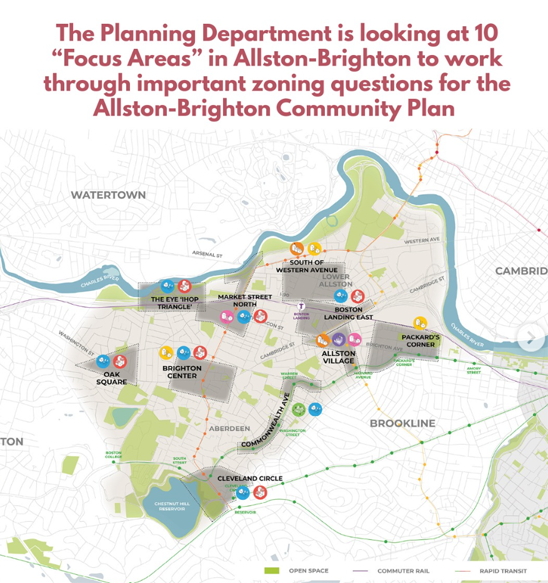
One-hundred-and-eleven Allston-Brighton residents met virtually on Zoom last week with the City of Boston Planning Department to learn more about zoning and discuss smaller-scale and residential zoning topics with the department ahead of the 2026 Allston-Brighton zoning map and the Allston-Brighton Community Plan drafts’ release in late spring.
The community plan will guide future development and investment into the neighborhoods, and it will build on factors including community knowledge and feedback, community needs and opportunities, along with other plans or development projects that are currently happening.
Grey Black, a Community Engagement Manager on the Planning Department, noted that a big theme of this year’s community plan is to ensure Allston-Brighton is “A neighborhood where everyone can put down roots, where seniors can stay, where young people can grow their careers and their families. They can find chosen family and become parents where children can grow up.” Black added, “We can’t wait on only the biggest projects to provide housing everyone in Allston-Brighton needs.”
According to the U.S. Census Bureau, since 2010, the neighborhood gained 4 percent additional children (aged 0 to 9) and 37 percent family-aged adults (aged 25 to 54), while Boston overall saw an 11 percent decline in children and a 20 percent growth in family-age adults. This growth “calls for a range of housing strategies across the neighborhood… at a range of scales to help support long-term residents that are here today,” noted Planning Department member Andrew Nahmias.
Since 2022, the Boston Zoning Board of Appeal approved 2,583 housing units, including 61 additional units by property owners and 210 units from small new construction. Planning Board member Jack Halverson presented strategies to address additional housing needs in the smaller residential areas, including allowing internal renovations to improve buildings, additions to existing buildings, new construction that fits into the current surrounding context, townhouses as pathways to homeownership in some places, and embracing small multifamily buildings (6 to 14 housing units) with required affordable and accessible units.
Halverson also noted that the increased housing density must be accompanied with parking strategies that include adjusting parking regulations, district parking facilities, and concentrating housing growth density around transit to reduce reliance on cars.
After the main presentation, Planning Department members opened breakout rooms for residents to ask questions about specific zoning topics, including small-scale residential housing and the community plan draft. In one of the small-scale residential housing groups, resident Benjamin Bressel noted he was “astounded at how difficult it was to add an accessory dwelling unit (ADU) with a sprinkler system, and it wasn’t making money for years.” Planning board member Kathleen Onufer, Deputy Director of Zoning replied that the requirements were set by building codes and fire codes. She urged developers that they must “be cognizant of alignment with the state building codes that zoning envelopes could fall into” to ensure people don’t “do things without a permit.”

In the 2026 community plan breakout room, resident Tom Crowley wondered how neighbors would react to the community plan and zoning proposal for housing for college students and who’s proposing the changes, as he felt that some changes would mean the residents would lose access to the process, as they would be shaped by the higher education institutions. Planning Department Ben Zünkeler reassured Crowley by noting the community plan’s development will remain a representative process, following the neighborhood’s master plan. “The planning process will strive for students and residents to live in harmony,” noted Zünkeler.
Nahmias noted that the Planning Department will conduct extensive engagement to collect feedback to refine the community plan and zoning maps’ drafts over the spring and summer. Residents can learn more about the plan and related upcoming events online at www.bosplans.org/ABCP.
Additionally, residents can learn more about zoning through the Urban Design Initiative’s interactive Planning Academy, scheduled for Feb. 25 from 6 to 7:30 p.m. More information is available at https://tinyurl.com/5c9fnupe
More in this section
Union says Allston Post Office loss = intentional privatization
Advocates say USPS actively trying to shut down post offices
October 1, 2026
JPHC: Change it after approval
JP Housing Committee wants changes to 3841 Washington Street already approved by the BPDA
October 1, 2026
Comments