News
Sides drawn up for 920 Centre Street “The Magnolia”
Big turnout at Article 80 meeting
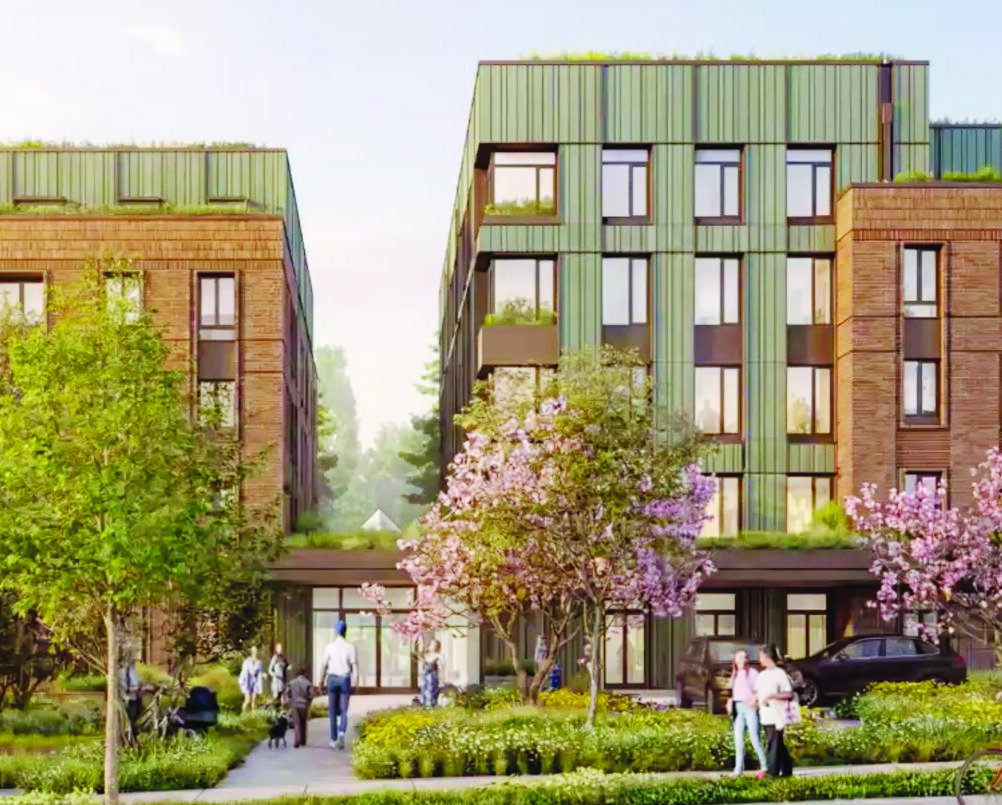
If the Boston Planning & Development Agency (BPDA), formerly the Boston Redevelopment Authority (BRA), wanted the July 8 Article 80 meeting on 920 Centre Street (the former St Clare’s monastery) held in person, it would have had to rent Thomas Hall at St. Thomas Aquinas Church to hold the 135 people at the virtual meeting; 125 of them are residents.
On the call was Susan Elsbree who was director of communications for the then-BRA for 16 years until 2014; she is now vice president of Benchmark, the public relations firm hired by the developer Sixteen Penny to manage the social media.
Social media is unprecedented in Jamaica Plain development and Sixteen Penny has been using Instagram to build public support for its plans for the monastery site.
The first full color blast came on July 2:
“Support!”
“Yes!”
“Sixteen Penny has proposed a $95 million investment in Jamaica Plain at 920 Centre Street.”
“One-hundred-and-fifty-eight new homes, 79 condominiums and 79 rental apartments”
“Thirty-eight affordable homes (24%)”
“A five-story building with 50-foot set back.”
“Sixty new trees.”
“One-point-nine-million-dollars in tax revenue.”
“Attend the public meeting and voice your support on July 8.”
Social media apparently is working: 25 people came on the call in support, 16 of whom said they were in their 20s and 30s.
“A big crowd tonight,” said Sarah Peck the new Boston Planning Department project manager; she brought on her colleague Quinn Valcich to help.
Sixteen Penny CEO John Holland, architect David Hacin, and landscape architect Mikyung Kim repeated presentations they each gave earlier at the July 6 IAG meeting.
Holland said on July 6 that the condominiums would all be market-rate.
“There’s no public funding,” he said. “The affordable apartments are self-financed. The condo sales are the economic driver for the affordability construction and landscaping.”
Hacin described the buildings’ scale, their organization and materials in detail; Matthew Mahew is the lead architect, he said.
“It’s a series of building pavilions in a landscape broken down in a U shape to break up the masonry building” with a 50-foot setback on all sides, Hacin said.
Resident Phyllis Dunn wanted to get down to the nitty gritty. “Stop looking at the drawings,” she said. “Look at the number. Why 158?” she said. “Why not 80? It’s because of profit.”
Ritu Choudhary was among those who wanted to live in Boston but faced hurdles.
“I’ve experienced how difficult it is to find quality affordable housing in Boston,” she said. “This project is exactly the kind of thoughtful investment our city needs. We can’t address the housing crisis without creating more homes.”
Daniel said he was in his mid 20s. “Housing is impossible,” he said, “I definitely support this.”
Joseph said he was 24 years old. “It’s difficult for people my age to have the opportunity to live here,” he said.
On July 6, IAG member Steve Lussier asked Holland, “Where’s the Arboretum now?”
Holland had already agreed to give the Arboretum a 50-foot buffer and a permanent deed attached to the condos of the 50-foot no-build with the Arboretum right-of-access for any tree work.
Holland said he didn’t know at the Article 80 meeting.
“No date set yet for a meeting,” he said.
Ned Friedman CEO of the Arboretum seemingly decided to use the public Article 80 hearing to respond to Holland’s offer.
“We’re not opposed to housing,” Friedman read in a statement. “There are five projects approved around the Arboretum.”
“We do not object to housing at 920 Centre Street,” he read. “But we object to the increase of five stories and 158 units.”
“This is equal to, if not larger than, what was proposed a year ago,” he continued. “We care about the visual impact, the shadows. Totally unrealistic drawings. Trees are impermanent. Buildings are permanent.”
Apparently the Arboretum prefers to negotiate through the Boston Planning Department and not with Holland.

“Our proposed solutions will be submitted in the comment letters,” Friedman read.
At a recent Longfellow Area Neighborhood Association meeting, Arboretum Chief of Staff Todd Washburn had a slightly different tack.
“We will be submitting a comment, our position on that project is that we do not object to the size, the density or the unit count,” he said. “We would like the massing to be changed so the visual sight line from the Arboretum is less impactful, but that’s basically our position.”
Resident Alan Wright of Roslindale came on the call with some context.
“Ned helped throttle the 22 Arboretum Rd. project because of marginal shadows on non-Arboretum trees,” he said. “His employees can’t afford to live in the city due to housing costs.”
Sister Mary Veronica came on the call.
“I represent the Poor Clares of Boston,” she said. “For 90 years from 1934 until 2023 this [building] was the heart of our devotion and our home in Jamaica Plain… Five years ago we made the difficult decision to move. The building was too large and had more operating costs than we could afford. We chose to develop the property into housing, which Jamaica Plain needs.”
“We wanted someone sensitive to the neighborhood and we found John Holland. We are grateful to John Holland,” Sister Mary Veronica said.
“The resources from the sale of the monastery are vital to our future mission of prayer and service and welcoming other sisters displaced from other monasteries.”
“We hope our neighbors will help this project to completion.”
Dan McCusker lives on Centre Street and was apparently feeling the spirit. He said he said he grew up in Jamaica Plain and was opposed. He was very critical of people who called in support but don’t live in the neighborhood.
“Its preposterous!” he said.
“I feel bad you can’t find housing,” he said. “I feel bad for people who need housing.”
“But I do pray. Every night. I believe in the power of prayer.”
“Sister Veronica? You still there? Pray with me: I hope this falls flat, unless it’s much smaller.”
“I hope the sisters get their money,” McCusker added.
Savannah Bell said she has lived in Jamaica Plain for a year. “I’m strongly in favor,” she said. “It’s a nightmare to find housing. All of the delays increase the costs and are just passed on to the renters and the buyers.”
Emily Calleyas said she lived across the street and was opposed.
“This is offensive. It’s all about money. This is about greed,” she said.
“These people in their 20s and 30s who call in? I want to say good luck. You won’t be able to afford the prices.”
Micah Sachs called in to say thank you.
“I fully support this project,” he said. “Thank you to all the young people who have called in. You don’t live here because you can’t afford to live here.”
Brendan King said he lived in West Roxbury and was in support.
‘The amount of complaining and extortion this project has endured is unbelievable,” he said. “It’s no wonder builders want nothing to do with Boston.”
Peck wrapped up the meeting and said the comment period had been extended until July 31.
A Sixteen Penny Instagram notification came on at noon last Monday (July 14): Picking up on a riff from Friedman’s statement it read, “The Magnolia: Benefits that last beyond the building. Investment in the future of Jamaica Plain.”
Comments