News
Canterbury Brook to get some TLC
Officials and residents envision a new path for the waterway
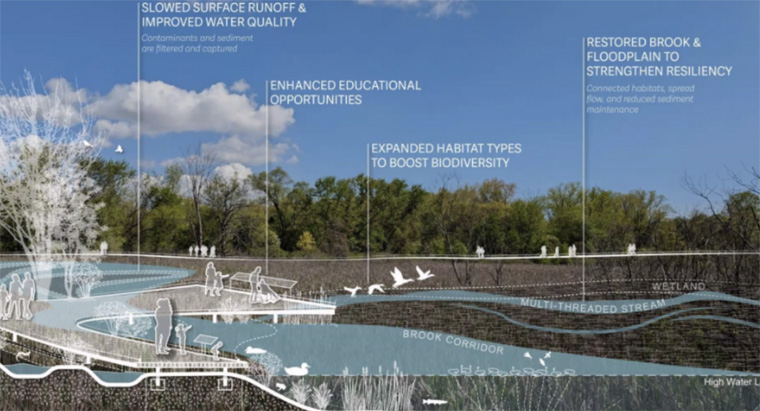
Thirty-nine attendees, including Mattapan residents plus officials from Mass Audubon and the Charles River Watershed Association (CRWA), gathered virtually on Feb. 26 to discuss the Canterbury Brook and Boston Nature Center (BNC) Wetlands Restoration project.
The aim of the project is to restore the wetlands surrounding the Boston Nature Center and Wildlife Sanctuary, a 67-acre urban wildlife sanctuary on Walk Hill St. on the Mattapan, Roslindale and Jamaica Plain lines.
Matthew Davis, a consultant from engineering consulting firm Brown and Caldwell, then explained Mass Audubon’s project is funded by a $400,000 Municipal Vulnerability Preparedness (MVP) grant from the Commonwealth of Massachusetts. The project aims to reconnect Canterbury Brook with the wetlands that once surrounded it, which will reduce stormwater flooding and reduce erosion, buildup of trash and invasive species that have affected the brook. The project’s preliminary design must be submitted by June 30, Davis explained.
Erin Kelly, Director of Ecological Restoration at Mass Audubon, presented a map of the Canterbury Brook watershed in 1832. She noted the expansive wetlands surrounding the brook, and those wetlands hugged the natural curvature of the brook. By 2024, however, “the flow pattern drastically changed,” she said. This was the result of early 20th century farmers filling in the wetlands to stop flooding and straighten out the brook’s water flow, partially by burying it underground.
Without those wetlands and natural water flow, Kelly explained, sediment built up along the brook’s banks and didn’t provide the natural absorption of water like wetlands did. Instead, the water dried out in the sediment, making the banks less resilient in floods. “Canterbury Brook has 50 percent runoff with trash and sediment.” Additionally, the runoff carries phosphorous into the water, leading to algae blooms, harming the brook’s wildlife.
Alex Hackman, Director of Ecological Restoration for Mass Audubon, then presented attendees with an opportunity to take advantage of the watershed’s former wetlands. “We’re just getting going, but this is a vision,” he explained. “The first part on the Boston Nature Center campus,” he added, “can help the water spread out and let it re-wet more of the site, making home for frogs.” Additionally, Hackman noted, there would be a new trail network and boardwalks to provide “wonder and awe to get close to critters,” which can work towards returning the area to what it was nearly 200 years ago. In addition to the wetlands, Hackman explained, the BNC’s land on the opposite side of Morton St. would be reimagined as a stormwater park like Alewife Station is in Cambridge. This park would subtly remove trash and provide clean water for the wildlife.

In different breakout rooms, residents met with representatives from Mass Audubon and the CRWA to respond to questions about different parts of the restoration project. Their feedback would become incorporated into its vision. Resident Nancy Aleo, who lives on American Legion Highway and Stella Road, hoped that the momentum of the discussion doesn’t stop with planning. “We need to pay attention to what’s happening where the Brook School wants to put PFAS in an artificial field 20 feet from the [Canterbury] Brook. It’s an unbalanced vision,” she noted. “Let’s put nature back in balance, not just with the sanctuary but for animals and humans, too.”
Hackman noted that long-term, there needs to be a commitment to sustainable waste removal. “The state would like to transfer ownership of the stream parcel to Mass Audubon,” he said, “but we need to have a commitment to sustainable waste removal” as they have limited resources to keep it clean. Hackman noted that it was “delightful” that members of the community came together to share their thoughts.
After the breakout sessions, Emilia Dick Fiora del Fabro, Senior Restoration Associate of the CRWA, noted that there are opportunities for the community to help clean up the area around the BNC and art activities for the youth. She also invited attendees to connect with the CRWA for additional workshops to provide feedback as part of the grant cycle.
Additional information about the project is available at https://www.massaudubon.org/places-to-explore/wildlife-sanctuaries/boston-nature-center/projects/restoring-canterbury-brook-the-boston-nature-center-wetlands.
Comments