News
City Council concerned over affordability agreement changes
Community Development Corporations could be the answer
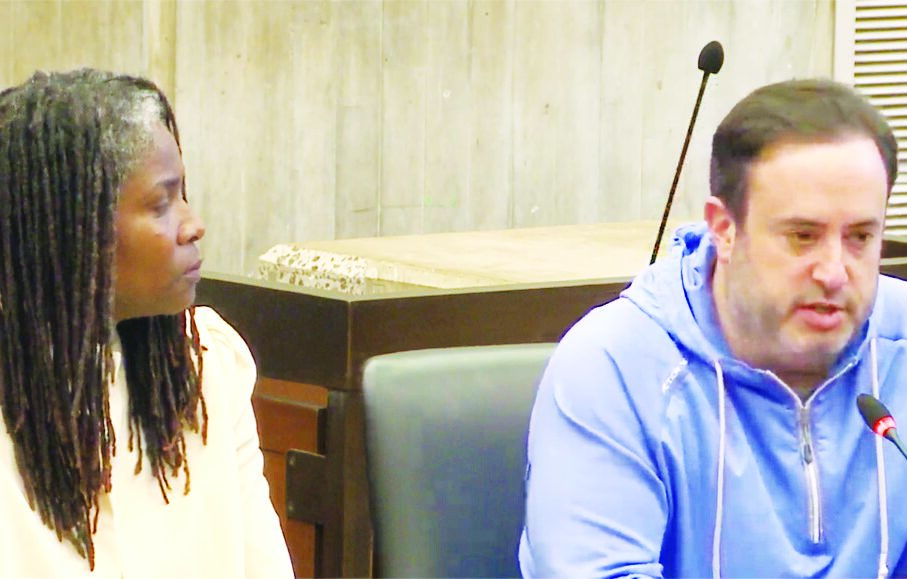
On April 2 at a four-hour hearing, the Boston City Council Housing and Community Development Committee discussed District 6 City Councilor Ben Weber’s docket “development costs and barriers to building affordable housing in Boston.”
Chaired by District 5 City Councilor Enrique J. Pepén, the hearing included two panels and 12 public testimonials.
All 12 speakers, including several from Chinatown through interpreters, spoke against any changes to signed affordable agreements.
Weber said the reason he filed the dockets was because two approved housing developments in Jamaica Plain asked to change their signed affordability agreements: Doyle’s, with 23 units with six onsite affordable, and 3326 Washington Street, 43 units with 10 onsite affordable units.
Both asked for significant changes; in the case of Doyle’s it was when it was three-quarters completed.
“What’s going on?” Weber asked. “We approved (these projects) five years ago on an affordable agreement that’s really not affordable anymore.”
Weber’s main concern was that these changes “were not adequately presented to the public.”
Two panels were convened: Policy and Prognosis.
Policy table was Sheila Dillon, chief of housing; Kenzie Bok, Boston Housing Authority (BHA) administrator; and Devon Quirk, deputy chief of planning.
Prognosis table was Lee Goodman of Watermark Development (of Doyle’s); Terronda Ellis CEO of the Jamaica Plain Neighborhood Development Corporation (JPNDC); Jesse Kanson-Benanev of Abundant Housing Mass; George McCarthy of the Lincoln Institute; and Jake Upton of Upton Partners (developer of 361 Belgrade Ave. in Roslindale).
Dillon, in her customary way, started out saying, “I don’t want to be gloom and doom. We’ve been incredibly productive.” She led off with a series of screen-share statistics: 5,151 of income-restricted units completed or permitted; $226 million of affordable contributions from developers have created an additional 3,600 income-restricted units.
“Regionally Boston has the highest percentage of income-restricted housing at 28 percent,” Dillon said. “We’ve raised $70 million to acquire housing,” she went on. “A very successful program. Five-hundred units taken out of the speculative market.”
Dillon, however, had to concede that “since 2015, major costs have far exceeded revenue growth.”
“Construction costs are up 38 percent. Interest rates are up 69 percent. Mortgage interest is up 133 percent. “We can meet [affordable] obligation different ways,” Dillon said. “There’s negotiation on how developers adhere to the[IDP] policy.”
Dillon did admit “3326 Washington Street could’ve been done better. A better process. We’re doing that.”
I
In phone call with The Bulletin on April 7, Dillon clarified this.
“Since then the city has met multiple times with the community, and so has the developer. In fact, I’m meeting with the developer again today.”
Quirk has a 10-year history with Jamaica Plain politics and personalities as a veteran of the Plan JP Rox.
“Since 2015 [when Plan JP Rox began], funding affordable housing is difficult chiefly because it’s hard to raise additional money,” he said.
On a screen-share Quirk listed the four constraints.
-
The end of pandemic era federal funds, the American Rescue Plan. Dillon earlier said the remaining $60 million in ARP housing funds would be spent down by year’s end.
-
A long backlog for low-income housing tax credits.
-
Reduced funding through linkage and the IDP fund.
-
Non-action by the state and federal on legislation to create additional funding sources.
-
But Weber wanted to get back to the process.
“On public notice, do we need a rule change?” he asked, admitting “I don’t want to hold up the process.”

“If we reopen this whole thing, do we loose projects with public presentations?” Weber asked.
Quirk replied. “A lot of work went onto the Article 80 revision,” he said.
Quirk said the average time to review and approve affordable housing process has been reduced 26 percent since 2022.
“The process is working as intended,” Quirk said referring to Doyle’s and 3326 Washington. “We have had community meetings. There’s a 30-day comment period [for change order notifications]. If a developer asks for a community meeting or if the Mayor’s office of housing asks [as with Doyle’s], we do a community meeting.”
“In the two cases you mentioned there was a comment period, a community meeting, and [in the case of Doyle’s] a Boston Planning and Development Agency (Board) vote,” Quirk said.
A vote on 3326 Washington St. was scheduled for Jan.14, 2026 but was abruptly pulled off the agenda.
Pepén called the Prognosis panel, and Lee Goodman spoke first.
“Costs have just skyrocketed. IDP is difficult to overcome,” he said. “It makes the sales numbers too low. You have to do tradeoffs to let developers build out.”
George McCarthy of the Lincoln Institute had two recommendations: “First, to overcome land costs to utilize city-owned and church-owned land. Second was an appeals process to see what the economic realities are. If 25 percent is too high, look at 20 percent, 15 percent.”
“Figure out what could you get to support this,” McCarthy said.
Terronda Ellis of JPNDC said, “Our work is solutions. We learned to do this very well. Collaboration. Examine that. Community Development Corporations (CDCs) and market-rate developers are all building the same thing.”
JPNDC and Watermark collaborated on Everett-Call housing as reported by The Bulletin in 2021.
“Did you know we did Stop & Shop?” Ellis said. “We partnered there for mutual benefit. We still get a percentage share of that property.”
In 1992, JPNDC and Mordechai Levin of Boston Community Ventures collaborated on the Super Stop & Shop at Jackson Square that opened in 1996.
“Is there a place for CDCs?” Weber asked. “Bring more CDCs into the conversation?”
Ellis said yes, but she had some advice. “Developers say ‘yes’ to a lot of things, but they’re not willing to be transparent,” she said. “CDCs can help with that.”
“We can tell you how much it’s going to cost. We can tell you how to mitigate risks. We have our numbers locked in before we go forward,” Ellis said.
More in this section
City and state officials rally for Allston Post Office
Protesting USPS closure at 47 Harvard Ave.
October 8, 2026
Second Happy Market plans to move to 3474 Washington Street
In the new Doyles building
October 8, 2026
BPIE Mentoring program celebrating 60 years working with Boston Public Schools
Program partnered 1,200 students with mentors this year
October 8, 2026
Comments