News
Evacutation Day Part 2:
On the road to sweet Athy, or Dorchester
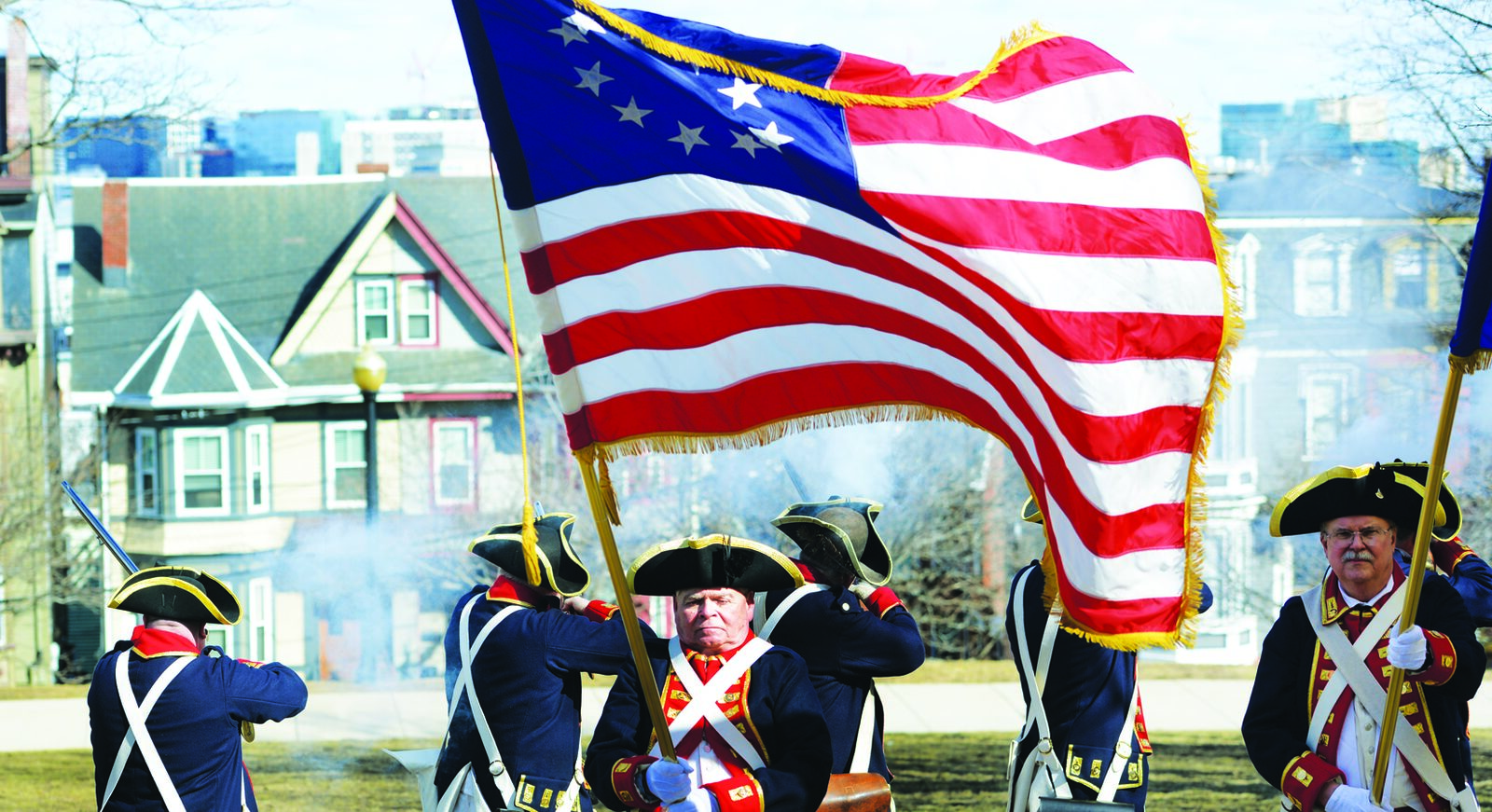
This is Part 2 of an exploration of Evacuation Day in Boston. Go to https://gvimes.link/evac to see Part 1.
When we last saw Boston, tensions between the Crown and the Protestant leaders of Boston were beginning to simmer.
The French and Indian War, known as the Seven Years’ War throughout the world, would begin in 1754 when George Washington, then the commander of the Virginia militia, ambushed a French patrol. Many Massachusetts men fought in what would become a global conflict, and were happy to help defend the country from Catholic Quebec. The war ended in 1763, when France signed the Treaty of Paris and ceded Quebec to Britain.
Britain won the war, but it was now in massive debt. It also now owned a vast territory thousands of miles away that was inhabited by people who did not want to be British. To the state, there were two logical responses to this: raise taxes on the colonies, and station a permanent military garrison in North America to ensure Quebec did not revolt.
The British colonists were less enthusiastic about this. A standing army seemed like a way to take away their liberties. The colonists also could not vote for any member of Parliament who might be able to argue legislatively on their behalf. The state noted that most Englishmen could not vote either, due to the requirement to own property. Only one in 12 Englishmen could vote. But the colonies were wealthier, and Massachusetts was especially rich. About half of free men in Massachusetts could vote, an indication of the level of prosperity even average citizens enjoyed that their cousins in England did not.
It was not that the colonists were against the concept of taxes. Massachusetts’ taxes were the highest of any colony, although they also had the best social services. But there is a difference between paying taxes to support excellent public education and paying taxes to support soldiers marching down one’s streets. Many of the new taxes also benefited the British East India Company and hurt colonial merchants, who were not legally allowed to trade with other countries.
It felt like despotism was closing in. In 1765, Samuel Adams said that the Stamp Act was designed to get people used to being enslaved, and Catholicism was the next logical outcome. In 1768, British troops arrived in Boston to begin enforcing the new taxes, and in 1770 British troops shot several men (what would later become known as the Boston Massacre). The Providence Gazette compared the Boston Massacre to Guy Fawkes’ plot: they had both been committed by those opposed to freedom of religion and liberty. That same year, there was a horrific famine in Bengal caused by the British East India Company, and American colonists wondered if they might be next. The effigy of the pope began to be accompanied by an effigy of Governor Thomas Hutchinson. The man who led the pope’s day procession was known as the Joyce, after the colonel who had led to the death of Charles I. The more Britain tried to tighten the screws, the angrier the colonists got.
Tea smuggling by the colonists had severely undercut profits of the British East India Company. In response, Parliament lowered the price of EIC tea. But this tea was still taxed; it was an attempt to get the colonists to be willing to buy taxed tea when it was sold at a lower price than smuggled tea. This is what led to Bostonians throwing a shipment of EIC tea overboard in 1773.
Parliament angrily passed several bills in response, designed to punish Boston. One of these blockaded Boston harbor, which meant severe economic consequences for a port city, causing thousands to flee. Another forced private property owners to quarter soldiers in their buildings; another took away the ability to vote for local elected positions; and another was that royal officials could be tried in England, and not Massachusetts. All of these were bad enough. The Port Act that blockaded the Harbor contained an advertisement for a 1715 anti-Catholic polemical book, which detailed the evils of the Catholic church in Spain. The ad said it was a book Protestant families should own so they would understand what it was like to live in a tyrannical society.
Then came the Quebec Act. It effectively fully legalized Catholicism in Quebec, including the right for priests to collect mandatory tithes. Parliament did not intend this to punish Boston, but the colonists certainly saw it as punishment. The outcry was immense. It was proof that Britain was fully and truly evil, and would do nothing to finally stamp out true godly Christianity from Massachusetts. Paul Revere did a cartoon of four Church of England bishops dancing around the Quebec Act as the devil and Lord North looked on.
In the fall of 1774, Suffolk County sent a list of resolves to Britain declaring their opposition to the actions of the British state. This included establishing Catholicism in Quebec, which they saw as dangerous to their civil liberties. In 1775, after the patriots had won at Lexington and Concord, a local minister would be cheerful that they could triumph over the antichrist. Young men would later enlist in the army so they could fight ‘popery.’
Providence was evidently on Boston’s side, which is why the British left in 1776. The signers of the Declaration of Independence hoped it would be on their side too that summer in Philadelphia. One of their reasons to declare independence was also the legalization of Catholicism in Quebec. (Earlier in 1776, Benjamin Franklin, accompanied by an Anglican and two Catholics from Maryland, had gone to Quebec to try and convince the Canadians to support the revolutionary cause. Unsurprisingly, this was unsuccessful. One of those Catholic men, Charles Carroll, arrived in Philadelphia too late to vote on the Declaration of Independence, but he did sign it.)
There were, of course, many other reasons for the beginning of the American Revolution. Other colonies had different origin stories and did not have the same sense of long-standing historic aggrievement with the British state, nor did they see themselves as ‘God’s new Israel,’ a place with a special destiny in history. But Boston did, and together with the masses of other colonists its men and women earned their freedom.

Much of this may seem foreign and alien to us. The idea that Lord North was going to convince the Pope to call a crusade against Boston – something one newspaper did suggest – feels absurd in 2026. But this was their worldview, for good or for bad. We can hopefully appreciate their sacrifices and virtues without agreeing with all of their positions.
The people who made ‘Evacuation Day’ into a holiday certainly did not agree with the over-the-top anti-Catholicism of Bostonians in the 1770s. Evacuation Day was not regularly celebrated after the war.
In fact, Boston had St. Patrick’s Day parades before any observance of Evacuation Day!
The reasons for this are due to late 19th century ethnic politics. The new country of the United States had issues with Great Britain kidnapping American men and forcing them to serve in the British navy, which led to the War of 1812. But after that was settled, the United States and Britain were largely friends.
Boston’s wealthy elite Protestant class – the so-called ‘Boston Brahmins’ – felt a logical cultural kinship with wealthy English people. More and more Bostonians left the Congregational church to become Episcopalian. A small handful even became Catholic, and enjoyed the world of England’s tiny elite Catholic minority. But even for those who stayed Congregationalist, their churches too began to have organs and candlesticks, and Gothic revival churches replaced brick and clapboard. Britain was not threatening. Of course these Bostonians were happy to be American; but the extreme anger of their forefathers at the British state was now alien.
But there was a new group of people who were angry: the Irish. Another colonial famine – considered by many historians now to have been a manufactured famine https://tinyurl.com/yn4ztcpw – had sent thousands upon thousands of Irish people to the United States, and as Boston was the closest city, many resettled here. Their religion was also persecuted by the British. They also yearned for freedom.
The elite Protestants did not like this flood of Irish immigration. There was Protestant immigration too, some from countries like Sweden and Finland, but others from Scotland and Canada who shared in the fierce anti-Catholicism and anti-Irish sentiment of British Protestants. But there were simply more Irish.
The Irish wanted to see themselves as American; perhaps even more American than these Brahmins who had shunned the values of their forefathers to coo at royal palaces while on grand tours. They even argued that the history of the Revolution was being erased in public school history textbooks to make Britain seem less bad. The first monument was enacted on Dorchester Heights in 1902. Evacuation Day seemed like a perfect day to make a holiday.
How could anyone in Boston argue against a day celebrating the British leaving during the Revolution? Conveniently, of course, it was on March 17, and the law making it a holiday in 1941 was signed in both black and green ink. But as much as it was St. Patrick’s Day, it also wasn’t; a day to remember that Boston had once been occupied by the soldiers of a distant king, and Boston had won.
More in this section
Historic preservation gets a surprise role in new housing starts
September 17, 2026
Comments