News
Boston celebrates the 250th
Heat wears off, but commitment stays strong
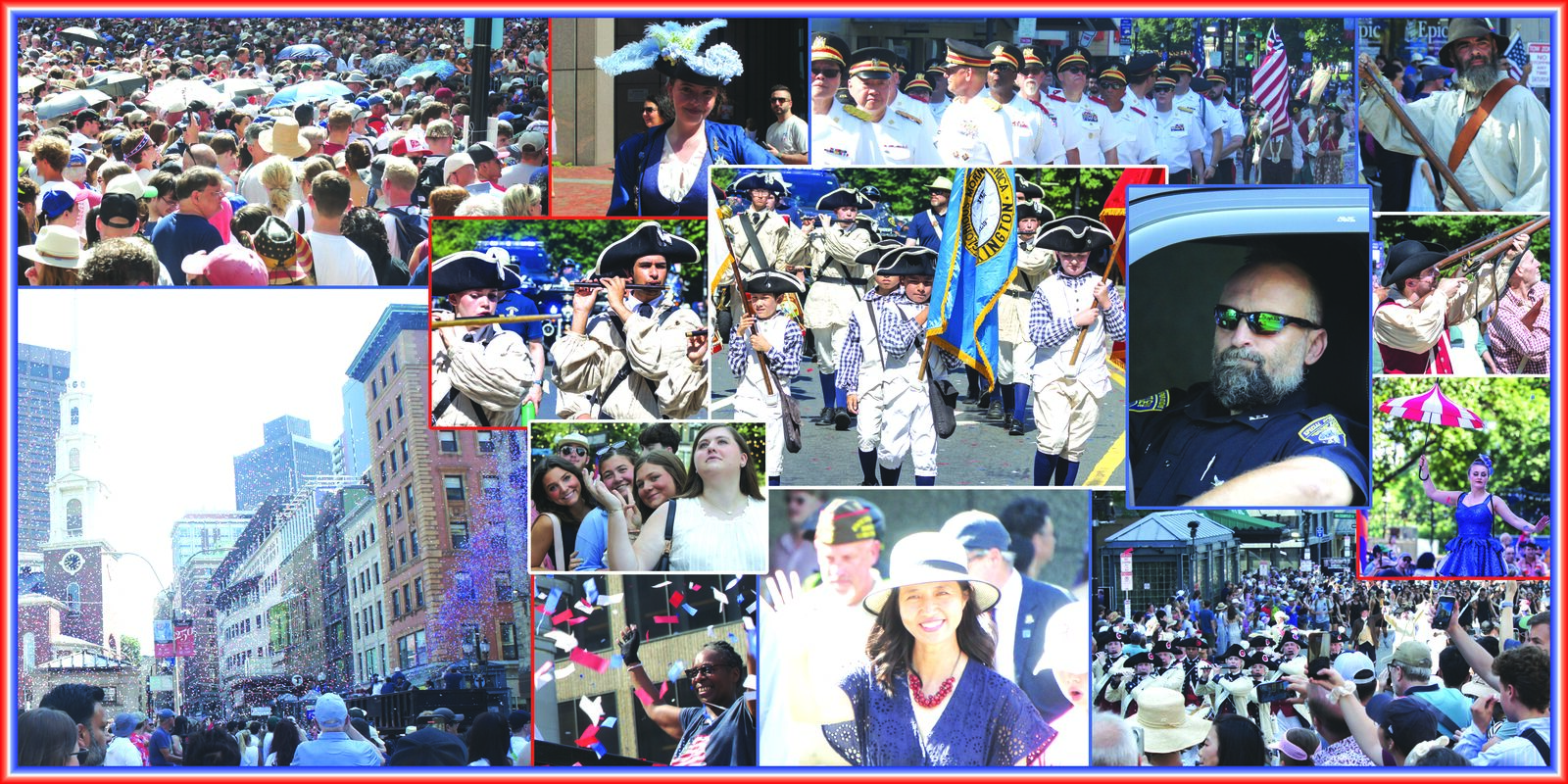
Despite the early morning heat on the parade route last Saturday, the Boston 250th celebration of the Declaration of Independence went off with nare a hitch throughout the day.
The parade went from Copley Square to Faneuil Hall, with a couple of stops in between, and ended with the 250th Oration, celebrated by Boston officials and invited guests.
Boston Mayor Michelle Wu said during her remarks that the city will continue to improve and live up to the standards set by the nation’s founding document.
“Boston is determined to build the America we deserve, by ensuring that the fullest meaning of those words – life, liberty, and the pursuit of happiness – actually reach every single person, every family in our community. And we couldn't do it without our people,” she said.
Wu said 250 years may seem like a long time, but on a human scale, it rings differently.
“When you break it down, 250 years comes out to about nine or 10 generations,” she said. “Ten generations ago, every one of our families was leading a very different life. Some had deep roots on this land going back centuries... Others lived thousands of miles away across oceans. Some had been brought here against their will to build this country, including for this very building. One generation at a time. They made their way to Boston. They crossed the Atlantic and the Pacific, the Rio Grande, the Darién Gap. They started over, worked impossible hours under grueling conditions. They fought for independence and freedom. Every American family has a story about sacrifice.”
Wu also shared the story of her own family, who first fled from China to Taiwan, and then here to the United States.
“Because they believed this place could give their children opportunities they never had,” she said. “And today their daughter stands here before you as mayor of the city where the American Revolution began. Maybe someday, the mayor of Boston will stand here on our 300th birthday or our 500th and count backwards through the generations to us. We have no idea who they'll be. And I don't think anyone in 1776 would have imagined me at this podium today. In fact, I know that for a fact.”
The keynote speaker for the day was Dr. Nathaniel Scheidly, who is the President and CEO of Revolutionary Spaces and is charged with protecting and restoring the Old State House and Old South Meeting House. He said his interest in this area of the past came from his mother, who began taking graduate courses in American History and wrote research papers on the Fourth of July orations – just like the one he was giving – that took place in the decades before the Civil War. He said then, many of those speeches lasted two or three hours.
“I promise I’ll be briefer,” he said, to some laughter from the crowd. “[My mother] did not care very much for the politics of the orators, and because she was a sleep talker, I would sometimes wake up at night to hear her arguing with them loudly. ‘Everett, you're wrong!’ In truth, uh, her language was a fair bit saltier than that, but I do wish that she could have been here all the same. During the 1760s and the 1770s, this great hall looked very different than it does today, or even in Edward Everett's day. It served then as the seat of Boston's Town Meeting and as an important gathering place for public dialogue. So many fiery speeches decrying parliamentary rule were given here by the likes of Samuel Adams and James Otis. So many boisterous protests – and also sometimes violent protests aimed at crown officials and prominent loyalists – were organized here that Bostonians in time came to think of this place, as we've already heard, as the cradle of liberty.”
Scheidly did touch upon the fact that not all Bostonians were included in that first declaration by the founders.
“They did not imagine that the rights of life, liberty, and the pursuit of happiness should in fact apply to those who were enslaved,” he said. “However enslaved Bostonians clearly imagined something very different when two years before the Declaration of Independence they petitioned the colonial government to be, in their words, liberated and made free men of this community, positing simply that they had in common with other men a natural right to be free. They were not waiting around for Thomas Jefferson and other members of the Continental Congress to tell them that they could use those words.”
Scheidly continued his theme that the Great American Experiment isn’t over, and that it’s up to everyone to continue to keep the dream alive.
“Perhaps John F. Kennedy put it best when he spoke right here at this stage in 1960,” he said. “And I'm not going to try to do his accent – ‘This old hall reminds us of how far we've been as Americans and what we must do in the future.’ Thank you.”
At the parade itself, residents cheered on the passing marchers and reveled in the sights and sounds they provided. Resident Hillary Innocent Taylor Seguya said he came out because he wanted to celebrate the freedoms he lacked in his home country of Uganda, and to learn from the Cradle of Liberty.
“I am coming from a country that has suffered under a military dictatorship for the last 40 years in Uganda,” he said. “The president, Yoweri Museveni, is a general who has been in power since 1986. As Ugandans, we are living under oppression and separation. But living here now in a democracy as old as 250 years, I have learned, I think, the importance of freedom. I want this independence to get back to my home of Uganda. So learning from Americans, how they fought for their independence and how they are living freely, that’s the same thing I want to see in my country.”
Seguya said he enjoyed the festivities and how people celebrated, as it was much different than the Oct. 9 celebrations in his country.

“Because in Uganda, it’s the opposite,” he said. “People are not having this vibe or energy when celebrating independence, because while we won independence from British rule, we’re still being arrested. There is impunity, there is corruption and there is oppression of dissenting voices. When you come to America, you see people set aside their differences and celebrate this day. When I see people here, I see people celebrating their vibrant colors of red, white and blue, which means a lot to me as someone coming from a third-world country still fighting for independence.”
New York City resident Lisa Guadagno said she came to the parade because she is studying U.S. Revolutionary history, and she thought she should come up directly to the source.
“This is the biggest day for us historians who study American Revolutionary History,” she said, noting she studies the period of history up to Washington’s presidency. “This is the birthplace of America. All the founding fathers were here, and I feel this is much better that Philadelphia. Yes, they wrote it there in Independence Hall, but they were all born here. This is the creation of America.”
Residents Kindra Sosa, Gustavo Sosa and their friend Maria all came recently to Boston, the former two from Seattle and the latter from Cleveland. They said they felt such a celebration in Boston was a unique experience they shouldn’t miss.
“We came out because it’s the 250th, it’s a big one, and this is a place with so much history,” said Maria.
“Being able to celebrate the Fourth of July in the heart of our nation’s independence movement is really exciting,” Kindra Sosa said.
“It’s something very special and we should just be here,” said Gustavo.
“And it’s not too hot here in the shade,” Maria added.
Mainers Scott Carney, Nancy Carney and Ed Ferullo said they came out for the first time to see this parade.
“It’s a big parade and we’ve never been out here to do it,” Ferullo said.
Residents Judy, Sarah and Peter said they came up from Maryland and Connecticut to take part in Boston’s history.
“We have family here and thought it would be a good time,” said Sarah.
About the author
Jeff Sullivan Covers local news and community stories.
More in this section
Union says Allston Post Office loss = intentional privatization
Advocates say USPS actively trying to shut down post offices
October 1, 2026
JPHC: Change it after approval
JP Housing Committee wants changes to 3841 Washington Street already approved by the BPDA
October 1, 2026
Comments