News
WR’s Joyce Kilmer remembered for poetry
April National Poetry Month
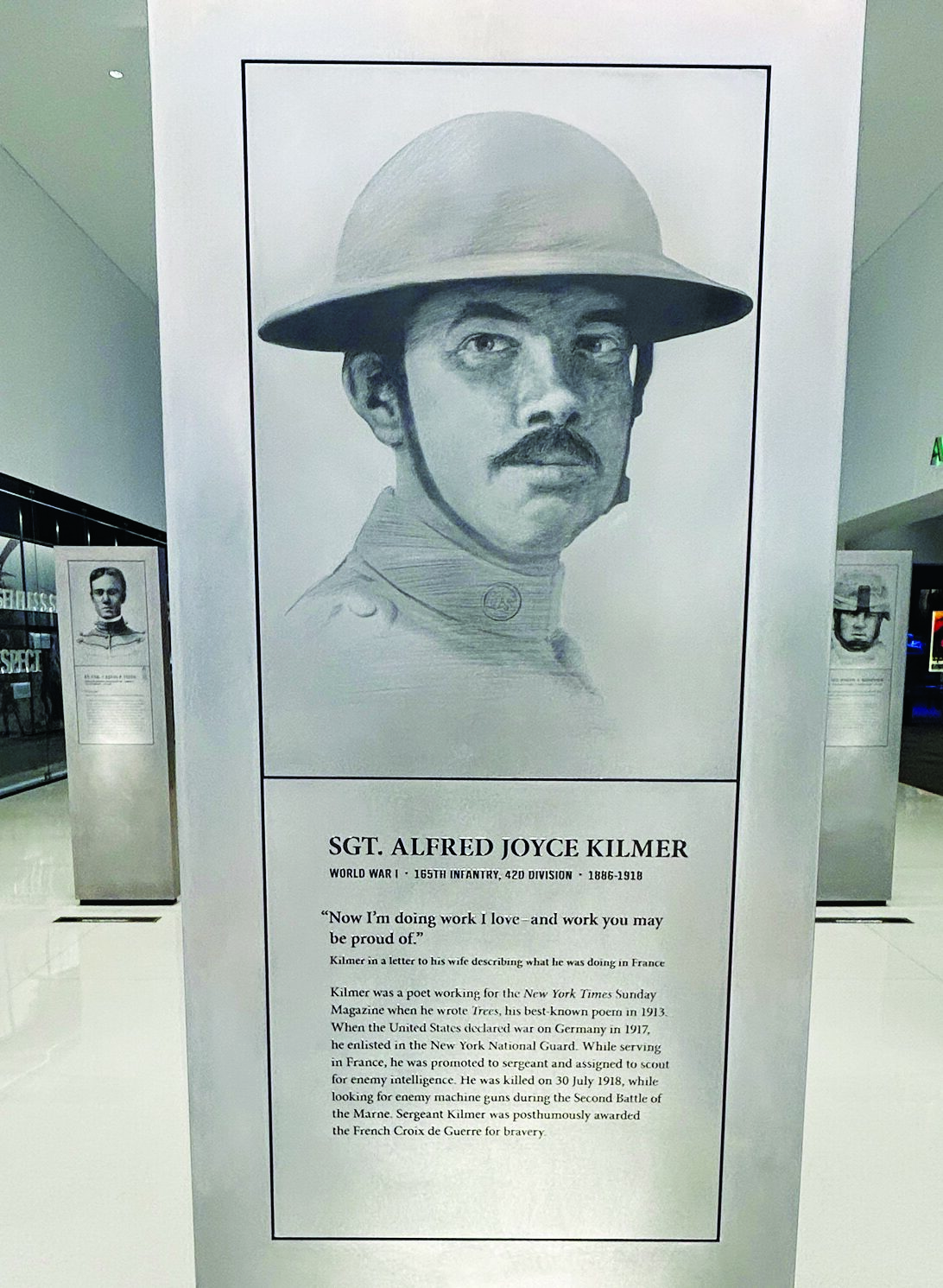
April is National Poetry Month. In West Roxbury, one poet is regularly remembered by the elementary school that bears his name: Joyce Kilmer. His poem “Trees” has been learned and recited by generations of school children, not only at the Joyce Kilmer School but around the United States as a standard part of English classes.
However, he might seem an odd choice to have an elementary school named for him in West Roxbury.
He had no connection to Boston, and “Trees” is not considered as impressive as the works of Beethoven or Mozart, West Roxbury’s other elementary schools named for figures with no connection to Boston. But while Kilmer did write other poetry, what made him important was what he represented. He was a Catholic poet at a time when there were very few American Catholic poets, a literary figure for a religious minority stigmatized as anti-intellectual. And then he died at age 32 on a French battlefield, like so many other American men in 1918.
Kilmer had been raised Protestant in an elite family in New Jersey. He attended a private high school, Rutgers, and then Columbia. He began a literary career, publishing his first volume of poems in 1911 as well as writing essays and book reviews. This led him to correspond with a Jesuit priest and English professor, James Daly. Kilmer had had an aesthetic and intellectual appreciation for the Catholic Church, but it was only after his daughter contracted polio and was paralyzed that he truly felt an experience of faith. He and his wife Aline converted in 1913.
He wrote about far more than trees. He wrote love poems to his wife, a poem about the Titanic joining the ranks of other sunken ships, and a poem about a train traveling through New Jersey.
But after his conversion, much of his poetry was distinctly religious, talking about the King of Heaven, the Annunciation, and the blood on the hands of Queen Elizabeth I. He also showed his sympathy with the Irish independence movement that was then taking place, writing a poem in honor of Joseph Plunkett, an Irish poet and revolutionary who had been executed after the 1916 Easter Rising.
In 1917, he enlisted in the American army. His friend and biographer Robert Cortes Holliday wrote ,“He believed in the nobility of war and the warrior’s calling, so long as the cause was holy, or believed to be holy.”

Kilmer asked to be transferred from his initial regiment to the 165th Infantry, which had previously been known as the 69th: an infantry unit nicknamed the ‘Fighting 69th’ by Robert E. Lee during the US Civil War and that was composed primarily of Irish-Americans. “With the Potsdam Palace on a truck and the Kaiser in a sack / New York will be seen one Irish green when the Sixty-ninth comes back,” Kilmer wrote. He was proud of his own Irish heritage, even if it was more likely to be Anglo-Irish than indigenous.
He wrote a poem about men dying from an artillery bombardment in March 1918 that again references this Irish association of the unit, writing, “And Patrick, Brigid, Columkill / Rejoice that in veins of warriors still / The Gael’s blood runs.” The chaplain, Father Francis Duffy, read the poem as a eulogy. If you’ve been to Times Square and seen a statue of a priest, that is a statue of Duffy. Kilmer would himself die in battle on July 30, 1918, and the poem would be read to eulogize him as well.
He was mourned throughout the United States. Katherine Brégy wrote about the immense outpouring of tributes in honor of Kilmer after he died. She wrote that “[T]his homage offers a luminous example of the influence and prestige which the intelligent Catholic artist can attain, if only his art be presented worthily, attractively – if only his life be conspicuous, in Pater's phrase, ‘not for rectitude of soul only, but for fairness.’”
Brégy would become part of the Catholic literary revival movement in the United States that began in the late 1920s, as priests and laity, men and women, converts and cradle, tried to develop a Catholic literary culture in a country that had very little. England had the luminaries who converted in the wake of the Oxford Movement, Gerard Manley Hopkins, and then-still-living authors like GK Chesterton and Hilaire Belloc. Who did the United States have? Joyce Kilmer.
In this light, it is entirely unsurprising that a Boston elementary school would be named for Kilmer. In the mid-19th century, even the supposedly progressive educational reformer Horace Mann thought Irish immigrant boys ought to attend trade school instead of a regular high school for which he did not think they were suited. The minister of West Roxbury’s Unitarian church, Theodore Parker, said Catholics hated public schools. By the 20th century, the levers of power had shifted. Boston Catholics, some now prosperous citizens, could dream higher for their children. They had opportunities their grandparents did not, including, perhaps, for poetry.
Comments