News
The Billings Family: Part 3
Parker’s role in the family story
While the United States is celebrating its semiquincentennial this year, West Roxbury is commemorating its 175th anniversary. To mark this milestone, The Boston Bulletin has been highlighting WR’s early history and sharing the stories of people who helped shape the town in the 18th and 19th centuries.
Earlier in July, two articles explored the family behind the Billings Field namesake: their businesses, landholdings, and civic involvement. Part one briefly discussed members of the Billings family, their friendship with Theodore Parker, and their ties to the Unitarian Church – https://gvimes.link/bllngs1 and https://gvimes.link/bllngs2
Not many people know that prominent members of the Billings family were neighbors and friends with Parker, as well as devoted members of the Unitarian Church. Among them were Benjamin Billings, a pelt monger who married a member of the prominent Weld family; Joseph Billings, who owned a successful sheepskin factory; and Robert Billings, a wealthy merchant and philanthropist.
Founded in 1712 as the Second Parish of Roxbury, the church was created to serve the growing population in present-day West Roxbury. In the early 1800s, the congregation evolved from its early Puritan origins into a more liberal Unitarian church.
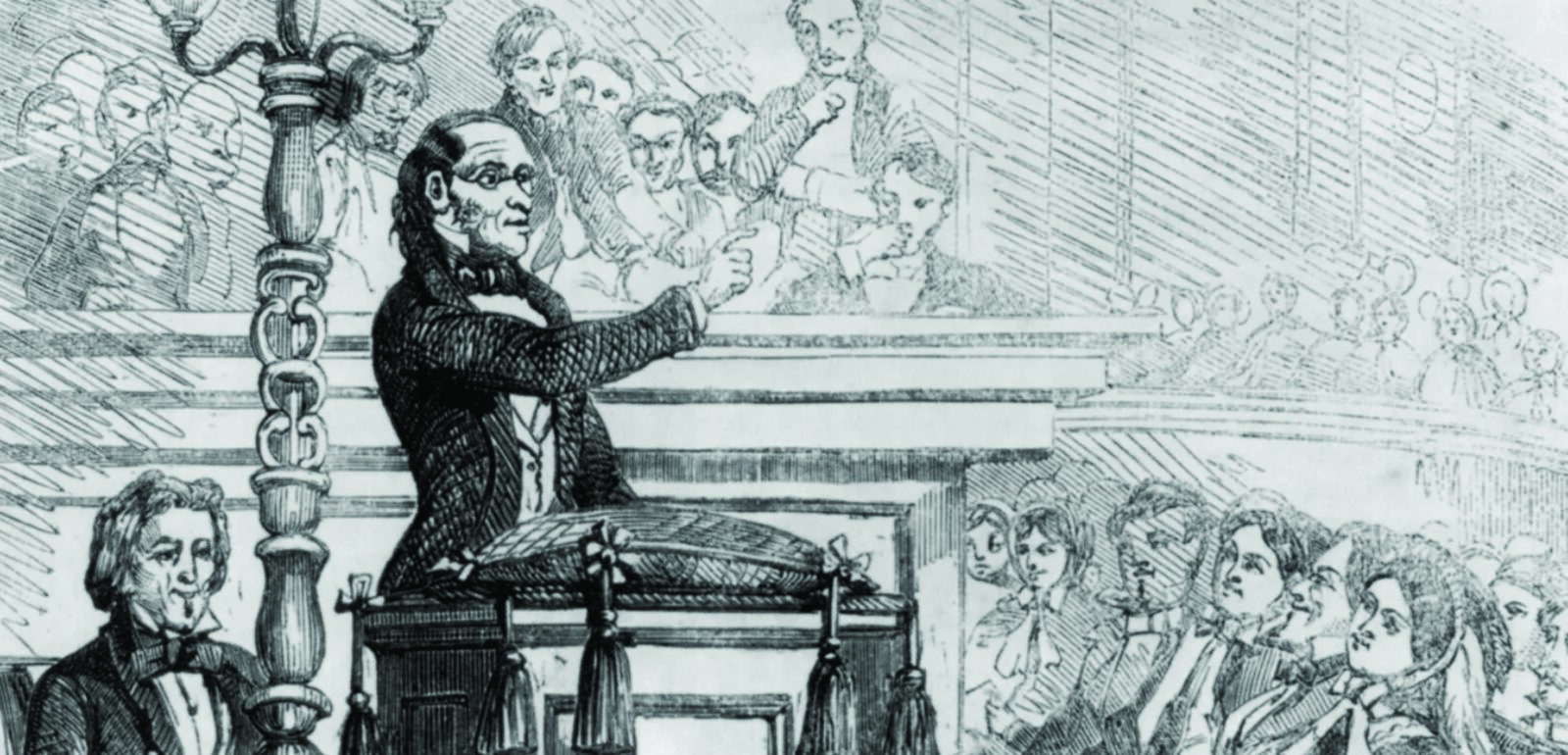
Theodore Parker (1810-1860) was an abolitionist, transcendentalist, and reforming minister of the Unitarian church. In 1837, he was called to the pulpit by the Second Parish of Roxbury (the church was renamed the First Parish of West Roxbury in 1854). His parishioners, including members of Brook Farm, were deeply devoted to Parker, supporting him even after his radical theology led to his banishment from the Unitarian brotherhood in 1846.
Benjamin, Joseph, and Robert Billings are discussed in a book about the Unitarian Church, titled “Some Recollections of the Pastors and People of the Second Church of Old Roxbury; West Roxbury,” which was written by Charles Mackintosh in 1901.
Robert Charles Billings is mentioned throughout the book: “Robert was a boy and young man who could often be seen on a Sunday morning taking his long, awkward strides from Boston to the venerable old church of his ancestors. After services he would call among old friends and return with his measured step to his Boston home.” Robert built a successful business career through his connection with Charles Faulkner, one of Boston’s leading merchants at the time.
Mackintosh noted that Robert will always be remembered by the church for his generous gift. In his will, Billings left more than $1.5 million to charitable/educational institutions, including Harvard, MIT, the Boston Medical Library, and the Unitarian Church.
Benjamin Billings is mentioned in the chapter on members of the Second Parish of Roxbury (the church was renamed “First Parish of West Roxbury” in 1854). He is described as a plain, honest man, who was “industrious, prudent, and public spirited.” The author recalled that Susanna Weld, Benjamin’s wife, consistently offered encouragement and advice to the young. “Generous wherever need appeared, active in town and parish matters, they raised a family of splendid children whom they taught to go and do likewise,” Mackintosh wrote.

Benjamin’s son, Joseph, was “the leading friend of the parish and its ministers until the end of his life.” Every minister at the Parish of Roxbury/West Roxbury considered him a true friend and supporter, and Joseph gave both his time and money to many worthy causes. His love for the parish and his hometown of West Roxbury knew no bounds. Mackintosh noted that even during disagreements within the parish, community members defended his integrity and remained confident that he always acted in the church’s best interests. “Some Recollections of the Pastors and People of the Second Church of Old Roxbury” includes a black-and-white photograph of Joseph “Joe” Billings. He has full, white hair around the sides and back of his head, with mutton-chop sideburns down the sides of his face.
In the spring of 1844, Parker wrote to Joseph from Bologna, Italy. In the letter, Parker expressed his belief that the United States had much to fear from “ignorant people and corrupt leaders” and discussed his desire to promote education. Two months later, Parker wrote to Joseph and his wife, Sarah Keith, reflecting on the meaning of their young son’s death. (Source: Theodore Parker Papers, Massachusetts Historical Society.)
In his book, Mackintosh recounts how Joseph and Parker would “hitch up the buck-skin tandem,” a single-file team of horses, and make a trip to Squantum to dine on clam chowder. They were often accompanied by other prominent WR community members, including Judson Chapin and Cornelius Cowing.
The First Parish of West Roxbury was badly damaged due to a fire in 1890. The blaze was classified as incendiary, meaning that it was intentionally set. Over a year later, the congregation began building the new meetinghouse on Corey Street. Inside the parish, a stained-glass window created by Louis Comfort Tiffany depicts a guardian angel. It is known as the Dana Memorial Window and was installed in 1893. An inscription below the angel reads, “Placed in loving memory of their mother, Sarah Billings Dana, and their child, Bradford Dana, by Samuel and Katherine Dana.” Sarah was the daughter of Benjamin Billings, and her son, Samuel Dana, was a successful cotton broker in Boston. Samuel and Katherine had been devoted church members for nearly two decades when they donated the stained-glass memorial.
In his 1853 work Ten Sermons of Religion, Parker famously wrote: “I do not pretend to understand the moral universe; the arc is a long one, my eye reaches but little ways; I cannot calculate the curve and complete the figure by the experience of sight, I can divide it by conscience. And from what I see I am sure it bends towards justice.”
The phrase “the arc of the moral universe is long, but it bends towards justice” was later popularized by Martin Luther King Jr.
Charles Mackintosh worked with Joseph Billings in the wool business, served on the City Council of Old Roxbury for two years, and on WR’s Board of Selectman for 12 years. His work, “Some Recollections of the Pastors and People of the Second Church of Old Roxbury,” can be read online here: bit.ly/4cUF88V
More in this section
First meeting of Jackson Square Neighborhood Association
Looking for ideas for 75 Amory
September 10, 2026
Fifth annual West Roxbury Art Walk starting this Saturday
Sidewalk sale and public art demos too
September 10, 2026
Comments