News
Librarian is ‘haunted’ by Belle Da Costa Greene
Draws crowd at WR Library
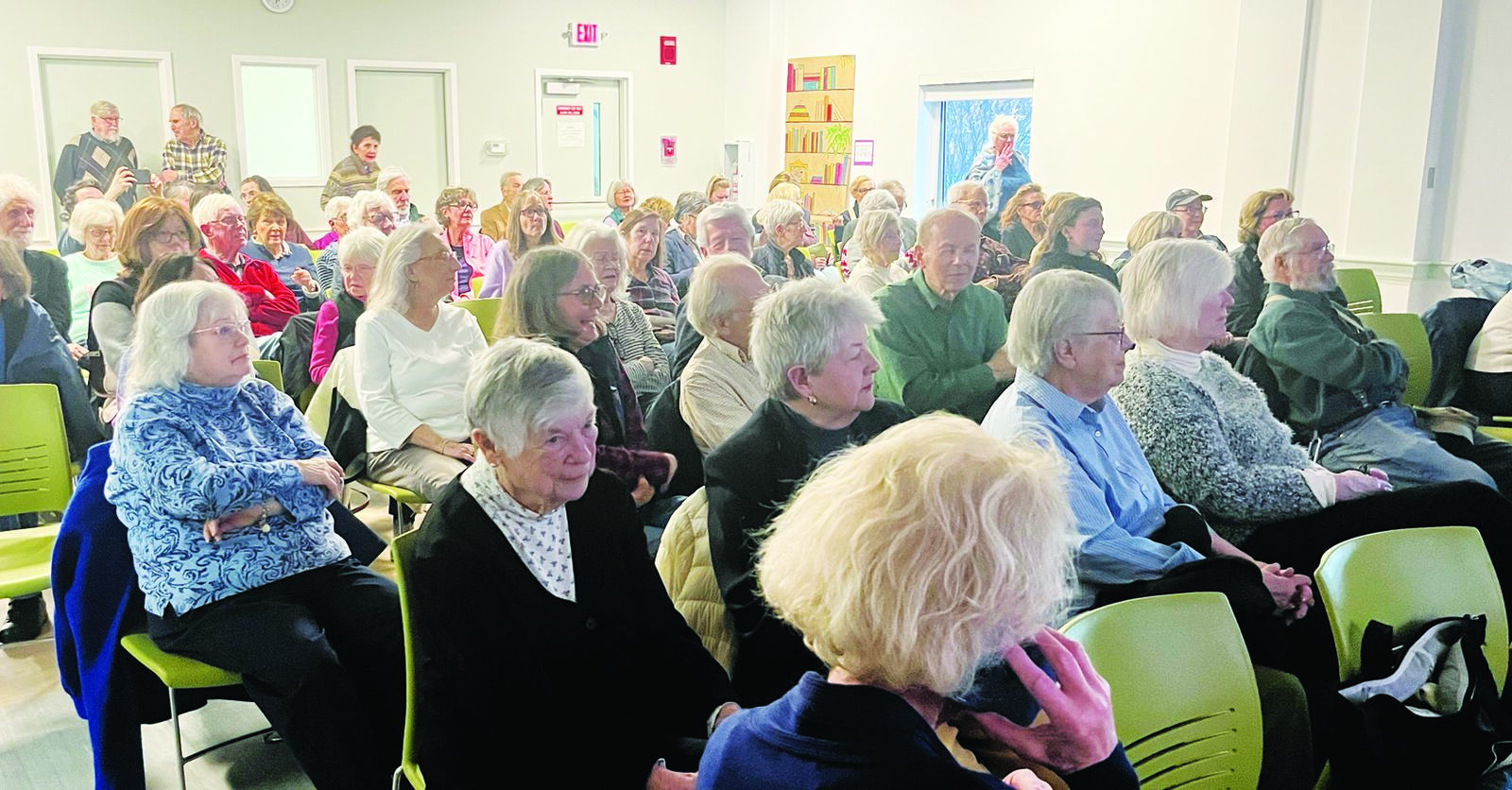
Librarian Erica Ciallela stood in front of a packed audience at the West Roxbury branch of the Boston Public Library, March 9, to discuss Belle Da Costa Greene, who was a librarian for much of her life for JP Morgan, a household name to many.
But Ciallela said it was Greene who had the more interesting life.
The way Greene even became a librarian for JP Morgan, according to Ciallela, was because his wife felt he had too many books and wanted them stored away from the house. No one imagined a library, per se. Ciallela described Greene’s education and career which eventually led to working for Morgan, but she also had to bring up the provocative issue of many assuming Greene was white despite being the child of prominent Black parents. This interesting nugget of truth came about when a biographer for JP Morgan, Jean Strouse, realized this while doing research for her book in the 1990s. She found out her birthplace, birth year and background were different than what people assumed. Strouse then wrote an article in The New Yorker magazine on this finding, and mainstream people became aware of Greene, as a Black woman.
Ciallela is a Belle Da Costa Greene fellow and has cataloged archives of Greene in the Morgan Museum. In addition, she provided future researchers a finding catalog since Greene’s work is so prolific. She is co-curator of the first Belle Da Costa Greene exhibit at The Morgan Library and Museum in New York which took place in 1924-25. She is now an outreach/instruction librarian at the Harvard Schlesinger Library for the history of women in America, according to the representative of Friends of the West Roxbury Branch Library, who organized the event.
Ciallela would often sleep on couches in the Morgan Museum while setting up the exhibition and feel haunted by “Belle’s ghost not being happy” with her interpretation of her life, she joked.
Greene was actually born Belle Marion Greener, to parents Genevieve Ida Fleet and Richard Theodore Greener in Washington, DC. Fleet was part of the Washington elite at a time when DC was very mixed, according to Ciallela, with freed and enslaved individuals. After marrying Greener, the two live in South Carolina where Greener was the first faculty member and librarian at the University of South Carolina. But due to reconstruction, the couple moved back to DC where they had five children.
Ciallela said Greene was deeply impacted by her immediate family who were readers, musicians and educators. The family eventually moved to New York City because the father was asked to be a part of the Grant Monument Tomb project in Riverside Park in Manhattan. Soon after he became bored living at home with family and became a diplomat in Russia; he cut ties with his family, which is when Belle changed her name from Greener to Greene.
Genevieve Fleet did not let this hamper her spirit, said Ciallela, and worked hard to provide a good education for all her children. Greene attended Northfield Academy before she going to library school. Ciallela showed a group school photo of Greene that an archivist sent her, which surprised her as she was under the impression that a 1910 photo was the earliest but this newly-discovered photo was from 1900.
“She has this look that me and my co-curator say looks like she’s saying ‘You want to doubt me, don’t you, but guess what!’ I’m just obsessed with it.”
Professors helped Greene earn a spot at Princeton University as a librarian. Ciallela then interrupted herself of Greene’s history to say she found it challenging to bring up the race issue without it overshadowing the straightforward and more important story of her career. In the exhibit, the curators put the issues concerning race in the center of the exhibit, featuring artists of the Harlem Renaissance. She did have diaries which she burned, so Ciallela said she can only wonder.

“What did it mean to be Black not only in America but in New York City, in a land where everyone thought it was safe but really wasn’t?”
Ciallela’s take on Greene is that she wanted to be seen for her work through her extensive archives rather than her race. While at Princeton, she worked as a cataloger and there she met Junius Morgan, JP’s nephew, who had no interest organizing his uncle’s books and thus set Greene up for an interview, after which she was hired immediately. Greene hired an assistant and got to work cataloging and also making acquisitions, such as a letter from a famous writer, and she also got the price down which was the moment Morgan realized the treasure he had hired. Ciallela then showed a picture of Bernard Berenson, an art historian, to whom Greene wrote at least 500 letters. They began as lovers and turned into best friends, and most of the letters were gossip. She mentioned a rivalry between Isabella Stewart Gardner and Greene on acquisitions, reflected in the letters. The letters are now institutional records at the museum, Ciallela said in a faux pompous accent.
Ciallela then showed pictures of a Balzac acquisition and said that Greene liked the marked up copies versus the neat copies, as that is where one saw the creative genius.
“What really put Greene on the map is this really boring book,” which Ciallela said she purchased at an auction for roughly $50,000, which was the largest amount of money spent on a book. “It made headlines across the world,” Ciallela said. “This librarian is taking the world by storm.”
And what made Greene even more interesting, according to Ciallela, was her zest for making contacts across the world in order to track down worthwhile books and verify authenticity.
“She garnered a lot of respect in a short amount of time.” In 1913, JP Morgan passed away, and Greene was in limbo and convinced his son, Jack, to keep the books and related materials. In 1924, Jack Morgan gifted the library to the public, and Greene became its first director until 1948. She died in 1950.
For more information on upcoming programs by Friends of the West Roxbury Branch Library, who organized this event, visit friendsofthewrlibrary.org.
More in this section
First meeting of Jackson Square Neighborhood Association
Looking for ideas for 75 Amory
September 10, 2026
Fifth annual West Roxbury Art Walk starting this Saturday
Sidewalk sale and public art demos too
September 10, 2026
Comments