News
Wood Ave. refresh sees mostly positive comments
Residents concerned about implementation
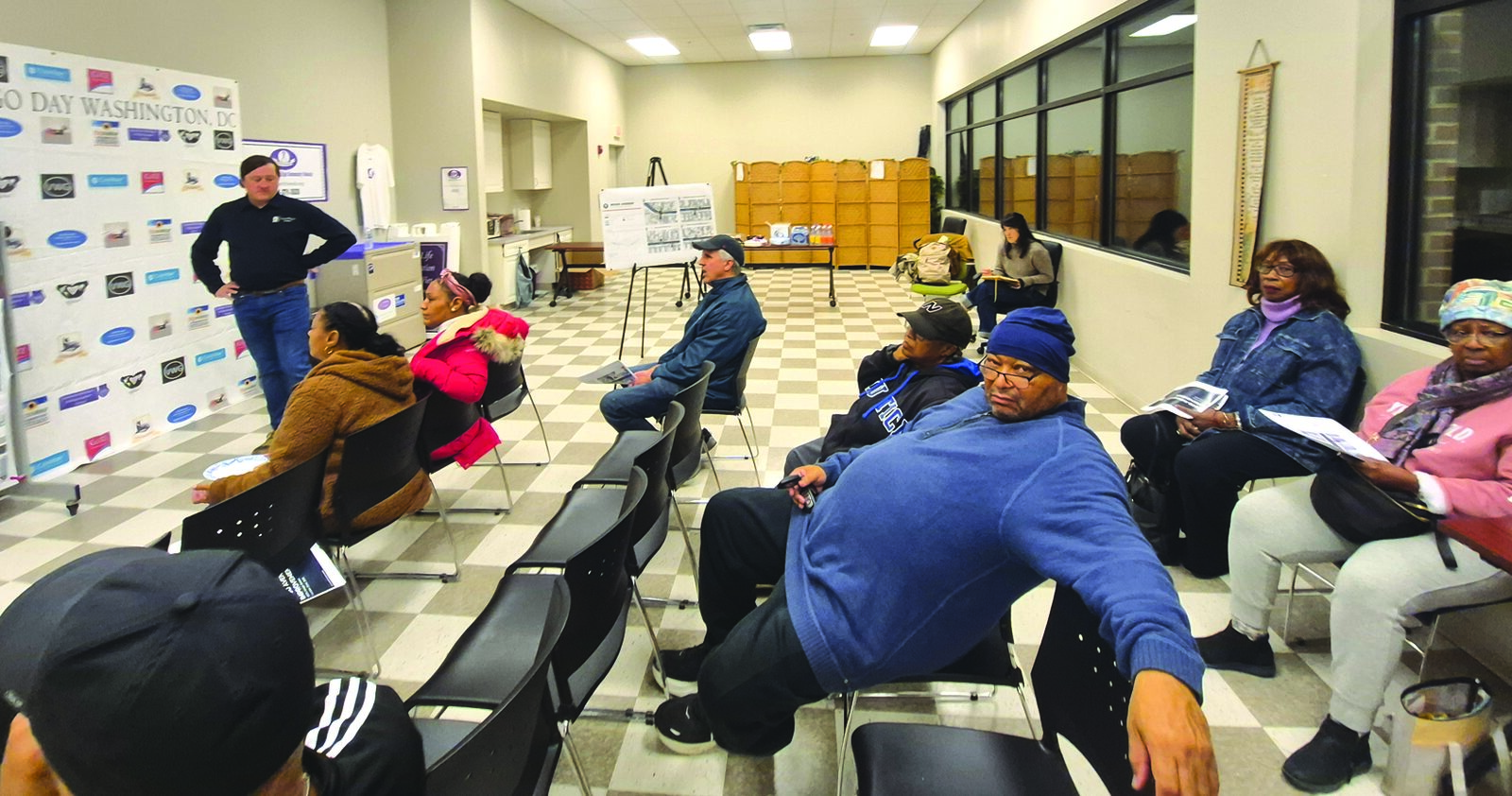
The Wood Avenue Safety Improvement project presented two meetings last week, one in-person and one remotely.
The virtual meeting garnered about 20 residents and the in-person about 15. Boston Transportation Department (BTD) Transportation Planner Daniel Milibrandt and Engineer Daniel Merrow both said the project, which has been going on for about two years now, is fully funded and designed to accomplish several safety elements along the stricken street.
Merrow said they counted cars for two days and found 20,540 vehicles went through the site, with more than 15,000 speeding when they did so.
First of all, they said the aim is to slow down drivers. Several pedestrians have been killed on the street in recent years, and high speed increases the likelihood of death or severe injury. So to do this, both said the idea is to have raised structures in the street like, speed humps (which are longer and more gradual than speed bumps), raised crosswalks, raised intersections, and raised tables (very long speed humps).
These raised structures, the pair said, provide “vertical deflection” at key spots.
“Which is the only thing that consistently works 100 percent of the time to slow down vehicles,” Merrow said. “That means you’re going to go up and back down in a vehicle.”
Most intersections will also have curb extensions and other bump-outs so that they won’t have such gradual turns that allow for speeding
Merrow said in the virtual meeting that they have been in contact with the Boston Fire Department (BFD) throughout the process. He said BTD actually wants more of the raised structures, but they are still negotiating with the BFD. Wood Avenue is an evacuation route and an ambulance route, so the idea is not to make the street more congested, just to slow down the traffic as it comes.
Merrow said the limiting factor on the street in terms of trip time is actually not speed, but the signaled intersections at both ends of Wood Avenue. The raised structures are designed to slow down traffic in between so that the street itself is safer.
The pair said in both meetings that several of the raised structures will be narrow enough to allow ambulances and fire trucks to pass without their wheels touching them – basically the wheels will be outside the humps and crosswalks.
Millibrandt said the project is funded at around $5.4 million with a 15 percent contingency. He said it’s being funded through the City of Boston Capital Improvement Plan, and is a serious chunk of change to make the street safer.
Merrow got into this a bit on the virtual meeting when a resident asked about the plan to install street trees. The resident said visibility in the area is difficult.
“This project is here to increase visibility at intersections because if you can see people, you can react to people,” Merrow said. “We are putting in trees, but none of them will make anything less visible.”
Millibrandt said in the in-person meeting that they are also installing about $2 million worth of new street lights on Wood Avenue as part of this project, which elicited an audible sigh of relief/approval from those there.

At the in-person meeting, the pair were asked about the earlier flex post chicane project at Wood Avenue that took place a few years earlier. A chicane is basically a structure that forces traffic to zig zag, reducing speed.
It’s okay if you missed it, enough people didn’t miss the flex posts early on that they almost disappeared. They were run over so much that they were considered more of a nuisance than a help. Merrow said the city did what it could at the time with the budget it had.
“We didn’t have any money or resources, and several people had died on the street,” Merrow said. “So we had to do anything we possible could to slow down vehicles. Chicaning the street, which is zig-zagging traffic back and forth, is a proven method, when done with materials that stay, to slow down vehicles. We were not allowed to do it in an effective manner. We did not have effective tools and so it was not effective for long enough. But it is an effective process that was implemented poorly.”
One resident pointed that such a chicane exists and works well in Brookline.
One other issue that came up was that of signaling and space at the Wood Avenue / Cummins Highway intersection. Several residents at the in-person meeting said they were concerned about the new timing of the signal lights there, as some have gotten stuck for several cycles.
Merrow and Milibrandt both said that the timings have to run for six months so that the department is not chasing its tail. Basically, when a signal changes from what it used to be, everyone needs time to adjust to the new pattern. They said after six months, when the dust settles, the BTD looks again to make sure the timing works.
Merrow said at this intersection, because it’s brand new from the nearly completed Cummins Highway rebuild project, they have cameras mounted to monitor traffic and will do a full analysis once they have enough data.
The other issue was that of space for fire trucks. Both said there would be, but then residents jumped on the fact that 18-wheelers regularly go down the road, creating bottle necks and more congestion. The pair said the traffic calming measures will discourage such trucks.
Merrow said those kinds of trucks are not supposed to be on that road and are not legally allowed to be there. He said calling the police and lodging 311 complaints could be a good way to get some police attention on that issue.
For more information and to see the slides from both meetings, go to https://gvimes.link/wdavesfty
About the author
Jeff Sullivan Covers local news and community stories.
More in this section
Getting by with a little help from his friends
Halloween party has big crowd in Rozzie
October 29, 2026
TCB bank president emphasizes importance of ‘Hello’
Centre Street lights also discussed at WRBPA
October 29, 2026
Comments