News
Dormers and deckers in Neighborhood Housing
Rezoning proposal sparks little debate in first outing
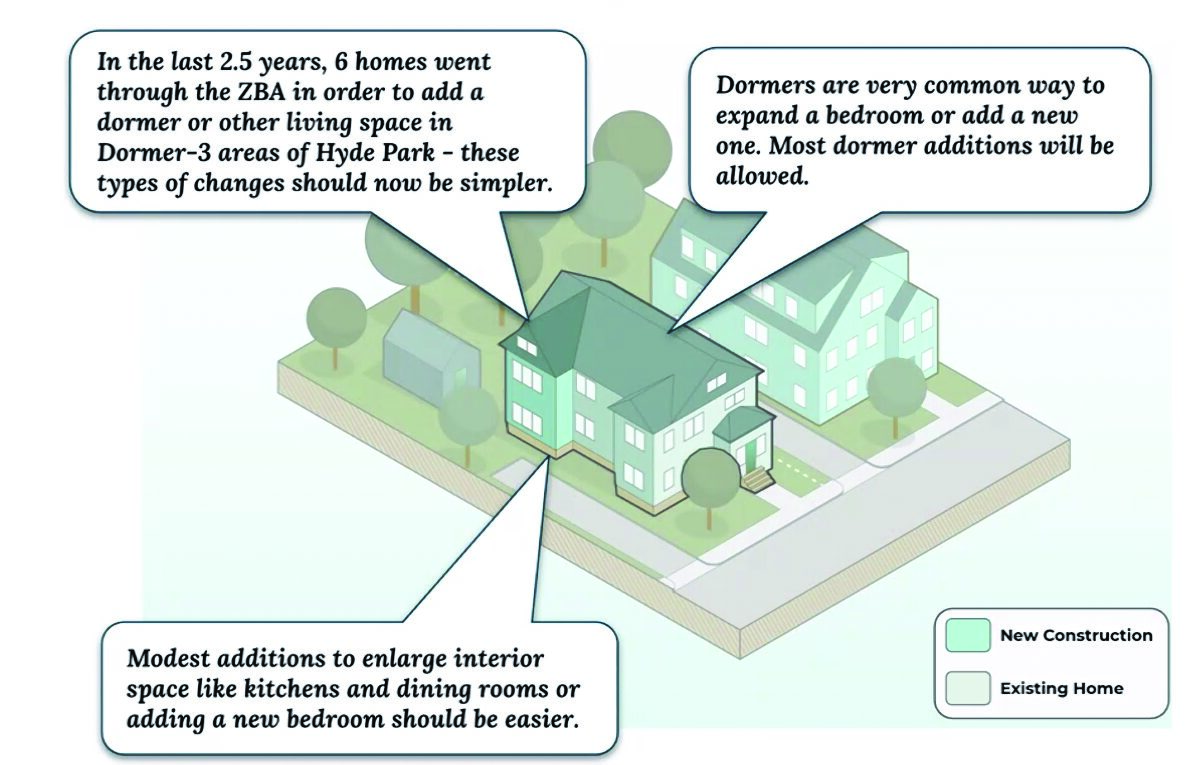
The new Neighborhood Housing rezoning districts are out now at the Boston Planning website – https://gvimes.link/nhbrhdzng – and several new small(er) residential districts are planned for the Parkway (Hyde Park, West Roxbury and Roslindale).
Boston Planning Project Manager Will Cohen said during Monday’s virtual meeting on the Hyde Park districts that the idea of the whole initiative is to bring zoning more in line with what’s already built. In Hyde Park, that means reconciling the rules where about 90 percent of the housing units in the neighborhood were built before the current zoning was enacted, and therefore are out of compliance.
The Boston Planning Department will be hosting an in-person meeting on Thursday starting at 5:30 p.m. at the Hyde Park Branch of the Boston Public Library at 35 Harvard Ave. There will be online and in-person meetings for Roslindale and West Roxbury in the coming weeks, and Cohen said they are reaching out to neighborhood associations to confirm meeting times with them as well.
Not only that, the team said around mid-September they want to host an outreach meeting to check in with residents on the process. There is also a survey available at the main page linked in the first paragraph of this article.
That means if you have such a property and you want to put a deck, dormer, addition or other small work on your property you have to go through the Zoning Board of Appeals (ZBA) process and apply for a zoning variance. This grants “relief” from the zoning code, even though the current housing stock was built before those rules were in place.
The new, overall zoning initiative is bringing about seven new residential-focused zoning districts to the neighborhoods – and Cohen said they will be expanding as soon as they can into Allston and Brighton – that, Planners say, are focused on residential uses and reducing the amount of zoning variances residents need to make changes to their properties.
The new zones are called Residential Dormer-2 (RD-2), Residential Dormer-3 (RD-3), Residential Decker-4 (RD-4), Residential Decker-6 (RD-6), Residential Garden-15 (RG-15), Residential Garden-50 (RG-50), and open space districts like cemeteries, public gardens, etc. (RG-65).
Each zone is different, but none of the zones are, at least exactly, single-family zoning.
The only new zone that looks somewhat like single-family is designed for multi-building campuses, that’s Residential Garden districts, which require at least 50 feet of setback on every side, but allow multiple buildings, heights of 45 feet (RG-15), 85 feet (RG-50) and 180 feet (RG-65).
The least dense districts are the dormer districts. RD-2 allows for two units as-of-right, based on the lot size. Cohen explained that they wanted to reduce the setbacks, as most of the older buildings were built before these zoning restrictions and therefore didn’t really take them into account when they were built. This means that if the house meets the lot size requirements and lot coverage (how much space the building takes up on the property), it can be upgraded to two units, either through an addition, if allowed by the fire code and the other myriad of state zoning requirements, or through an ADU (accessory dwelling unit such as a finished basement, in-law apartment, detached cottage, etc.).
The zoning provisions allow that any home built after 2027 would be allowed to go up to three units in RD-2.
Hyde Park is doing mostly RD-2-4 zones, with RD-6 taking up only a small amount of zoning space, and garden and open space districts taking up previously open space (Monterey Hilltop near the Sherrin Woods Urban Wild appears to be the only one on the map at this point).
Also, perhaps somewhat interesting for those following the Crane Ledge Woods fight – https://gvimes.link/clwc – the property itself is whited out for the most part, with one area within the property being designated as RD-3, several areas surrounding the property are designated as Urban Wilds in the OS-UW zoning.

The use tables explain in great detail how many units, the density, the setbacks, etc., each district has – https://gvimes.link/usetbles – but the basic rule of thumb is if the number goes up, so does the density. RD-2 allows up to two units and RD-6 allows up to six units, all as-of-right, depending on the lot size and dimensions. Cohen said they tried to basically make it like a sliding scale, that the more land on your lot, the larger you could go. Cohen said about 45 of the lots in the neighborhood will be going RD-2, 140 to RD-3, 115 to RD-4, and 10 to RD-6.
At the Hyde Park meeting, Cohen and the Boston Planning team went over the details for the neighborhood, and participants spoke mainly in favor of the proposal.
Residents Michael Grant, Tracy Simmons, Stephan Jacobs, Monicellia Pruitt and Brian Putnam all expressed interest in the proposal. Grant, Simmons and Pruitt expressed their desire to take advantage of the new zoning as soon as possible with additions and ADUs.
“We’re looking to put in an ADU on an almost 11,000-square-foot lot, and for planning purposes, I’ve been deferring almost anything I can in hopes all of these changes would come to pass,” Grant said.
“We have funding and we want to move forward with architecture,” said Simmons. “But if this is going to take another year, we don’t want to wait another year to start it.”
Jacobs at least one other resident said they were concerned about fire codes, basically buildings being too close together and therefore a risk to one another if one catches on fire. Jacobs said he’s worried because he has seen several developments elsewhere build right up to the lot line.
Cohen said there is an added expense to that in requirements for sprinklers and other fire safety equipment, and that the closer buildings are, the more of that they need.
Other than that, those commenting in the chat and on Zoom were positive.
That may not be the case for Thursday’s meeting.
About the author
Jeff Sullivan Covers local news and community stories.
Comments
I'm glad you cover these meetings, and I support the new Neighborhood Housing Zoning. But there are several misstatements of fact in the article about the zoning. For example, new construction in R2 districts after Jan 1, 2027, can only have two units, not three. Existing buildings in those districts can add up to 2 more units, for a total of three. But new construction can only be two units total. Also, the residential garden districts are nothing like single family, they would allow multifamily buildings of different densities. R2 Is the closest to single family. And I don't believe Will Cohen said, the more land you have, the more you can put on it. I believe large lots with single family homes currently are quite restricted in what they can put up - many of these are designed R2 in the new zoning. I advise you talk with the the zoning team about these details so you can clarify them for your readers.
I think you should take a closer look at the zoning. The two-to-three building limit in R-2 districts becomes three to four if the developer grants an easement of five feet to the city (see p. 8). All districts can have 5-to-16 unit buildings with up to 4000 sq. ft. floor plates with ZBA approval (see p. 6). R-2 and R-3 lots will require larger lots for this to happen than R-4 districts, but some houses along Bellevue Street in West Roxbury, for example, would easily meet the standard of a minimum of 25% building lot coverage. The ZBA would be required to take compatibility into account but also “affordability and accessibility” (p.5). There are a lot of hidden workarounds that allow developers to do much more than what they appear to be able to do on p. 2 . I think this is being rushed through, with the plan dropped and meetings held in the summer when many people are on vacation. I hope the city will consider holding more meetings in the fall when more residents are paying attention.
https://www.facebook.com/share/v/1HAjVZcpkh/
Thanks for your reporting on July 30 about the Roslindale meeting. To follow up: We did exactly what the Deputy Director of Zoning asked during Squares and Streets. We connected the City with the residents and business owners its rezoning would affect most. Latino neighbors offered to reach the excluded. Survey experts volunteered to advise on outreach. We brought the community to the City so that Planning, Transportation, and Economic Opportunity could hear their voices. Participation ended up 82% white (778), 6% Latino (54), and 4% Black (38) — in a neighborhood that's under 50% white, 27% Latino, and 24% Black. Then the City quietly stopped publishing the numbers. We did our part. The plan moved forward anyway. https://drive.google.com/file/d/1kYxS9LlLwrLn9xfJE6B4PkpIc_aR--v7/view?usp=drive_link