News
Evacuation Day: Part 1
Rumblings and portents
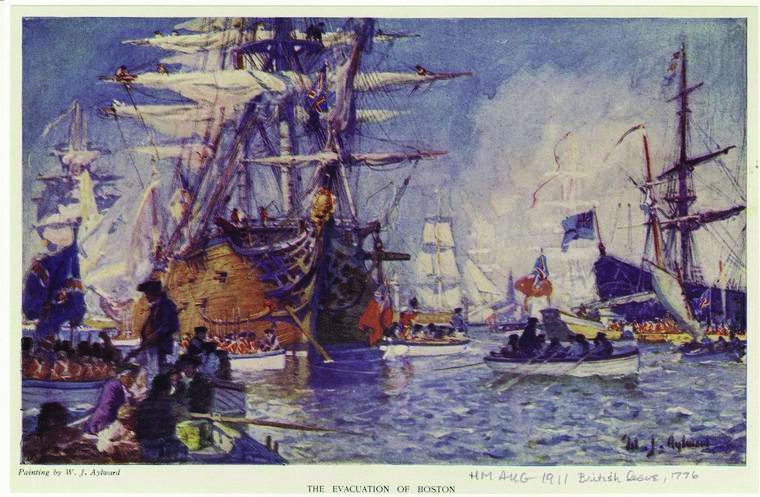
March 17, 1776. The British were fleeing Boston. They had spent a miserable week on board ships in Boston Harbor, waiting for a favorable wind to allow them to leave. A year earlier the British officers had been enjoying a small musical procession for St. Patrick’s Day culminating in a service at King’s Chapel, Boston’s oldest Anglican church. The British did not anticipate that the colonists would be able to fight back against the might of the empire. But now General William Howe realized he had to retreat.
“We have been afraid to speak, to write, almost to think. We are now relieved, wonderfully delivered,” wrote the Rev. Andrew Eliot, a Congregationalist minister who was one of the few clergymen who had remained in Boston. He was grateful to no longer live in a “garrison town.” The city had been under siege for eleven months, and under some form of military occupation since 1768, when the British army first arrived to enforce new and unpopular taxes. Every aspect of life had been disrupted. Private citizens were forced to quarter soldiers in their homes. Churches had been desecrated by being used as stables. Eliot noted that, now that the British were gone, Bostonians would finally have access to the coal the British army had kept for themselves during the winter of 1775-1776.
Would anyone in Boston have noticed March 17, 1776 was St. Patrick’s Day? Perhaps Henry Knox, the man who had dragged captured British cannons over 200 miles from upstate New York to perch on Dorchester Heights. His parents were Protestant Irish immigrants. But in general, Bostonians, descendants of strict Puritans, were not enthusiasts for saint’s days. Many did not even celebrate Easter; if it was not mentioned in the Bible, Congregationalists were not interested in it. But on what was Holy Saturday that year, April 6, 1776, Bostonians removed one of their own from his grave: Joseph Warren, the decorated officer who had died a year earlier fighting a private on Breed’s Hill. He would finally be given a proper military funeral on April 8. Abigail Adams wrote of the noble cause for which he had died a martyr. If there was any celebration that year that marked the end of British occupation, it was Warren’s funeral.
Likely some of the men on board the British ships were Irish. The first ships left Boston at 4 a.m. on March 17; perhaps by the time it was daybreak, they would have looked over the starboard side and thought of their distant home, 3,000 miles away across the Atlantic. Many Irishmen served in the British Army, existing in an uncomfortable dual identity of colonial victim as well as colonial enforcer. The regiment that had perpetrated the Boston Massacre had numerous Irish soldiers in it. They were His Majesty’s subjects just as someone from England was.
And just as someone from Boston was. The British ships leaving that day contained not only men in their bright red coats but also over a thousand civilian men, women, and children. They were Bostonians who loved their city, but they loved their country too, and to Loyalists, that country was Great Britain. These Loyalists would arrive in Halifax, Nova Scotia, on April 1, a grim fishing village that was scarcely equipped to handle ten thousand new residents.
The Loyalists did not understand their rebellious brethren. Britain was significantly better to its colonies than France or Spain were. The local-born elite class enjoyed privileges and powers that “criollos” (a person from Spanish South or Central America) in “New Spain” never would. For the working class to be angry was perhaps understandable. But why would their fellow elite men like John Adams want to secede?
The answer to that is complicated. But for many in Boston, the Revolution was the end result of almost 150 years of fighting against the British state for freedom.
Their forefathers had fled England to have a truly godly colony, a shining city on a hill. It would be a place of a better, purer Christianity than in the degraded Church of England. The Puritans were frustrated by the continued proliferation of saints’ feast days that seemed to be more about excessive drinking than anything else. They wanted Sundays to be only about God, not sports. And they did not like that a distant powerful bishop could yank a beloved priest and replace him with an incompetent (or worse) cleric at will. The Puritans also saw it as their duty to be a Protestant bulwark against the kingdom of the Antichrist the Jesuits were trying to raise up in nearby Quebec.
The Church of England did not like that the Puritans wanted something better. Archbishop William Laud had chased them out of England by threatening to imprison Puritan clergy, and then he tried to take their colonial charter away. But God delivered them from the evils of Laud, as noted by Josiah Quincy in 1774.

Evil, of course, was a constant problem. Jesuits might be lurking behind any tree, ready to pounce upon an unsuspecting Puritan and force him to become enslaved to the Pope. Bostonians cheered for Cromwell, who promised to remake England as a godly Commonwealth. But he was defeated, and the monarchy was restored. Anglican Charles II and Catholic James II were frustrated by Massachusetts’ insolence. The minister John Eliot was forced to apologize for his anti-monarchical text. He wanted a different form of government: theocratic rule by godly men, elected by other godly men. An appointed royal governor opened up the colony’s first Anglican church in 1686. The minister Increase Mather was outraged. The Book of Common Prayer was clearly a slippery slope to Roman Catholicism, which itself was only a slippery slope to resurrecting Roman paganism. The right to vote was changed from being limited to men who were church members to men who owned property, which was the norm in Britain.
This may seem like irrelevant historical information to us today. But it was very much not irrelevant to Boston’s patriots in the 1770s. They saw themselves as part of a cosmic struggle between good and evil, between true religion and idolatry, and between freedom and tyranny. They were fighting not only for free trade and fair taxation but to not be forced to convert to Anglicanism, or worse, Roman Catholicism.
In the 18th century, Boston grew and prospered. Congregationalists begrudgingly learned how to co-exist with Anglicans, although they did not like it when Anglican converts smugly said that Anglican priests were the only real clergymen in New England. Learning to co-exist with Catholics was another matter. The last woman hanged for witchcraft in Boston was hanged largely due to her Catholic faith and the fact that she only spoke Irish, not English. In a skirmish against indigenous tribes in Maine in 1724, colonists scalped a Jesuit. There were several military campaigns against Quebec, which ended in draws, but not without Massachusetts militiamen smashing statues in Catholic churches.
Strict Puritanism and hatred of the state receded somewhat as the 18th century progressed. Working class Boston men began to observe Guy Fawkes Day, which commemorated the failure of a Catholic plot to blow up Parliament in 1605. In Boston it was known as Pope’s Night, and it involved the ritual burning of an effigy of the pope. The elite shed their plain clothing for more elaborate frock coats and gowns and began to collect European art (and acknowledged that Catholic art was better). Cotton Mather, Increase Mather’s son, may have hated the English church. But he was also a proud member of the Royal Society, an academic society founded by Charles II. Bostonians were pleased when Charles Stuart (also known as Bonnie Prince Charlie and the Young Pretender), who was the last Catholic claimant to the British throne, was defeated in 1746. Bostonians were British Protestants, and mostly happy to be so. Ministers preached hundred-year-anniversary sermons in 1749 commemorating the death of Charles I under Cromwell that talked about the evils of monarchy and bishops. They could do this because they were in Massachusetts, not London, and they were happy this was the case.
But this would change.
Check in next week for the full story.
More in this section
First meeting of Jackson Square Neighborhood Association
Looking for ideas for 75 Amory
September 10, 2026
Fifth annual West Roxbury Art Walk starting this Saturday
Sidewalk sale and public art demos too
September 10, 2026
Comments