News
Bellevue Hill on zoning and zone fares
City budget also on docket
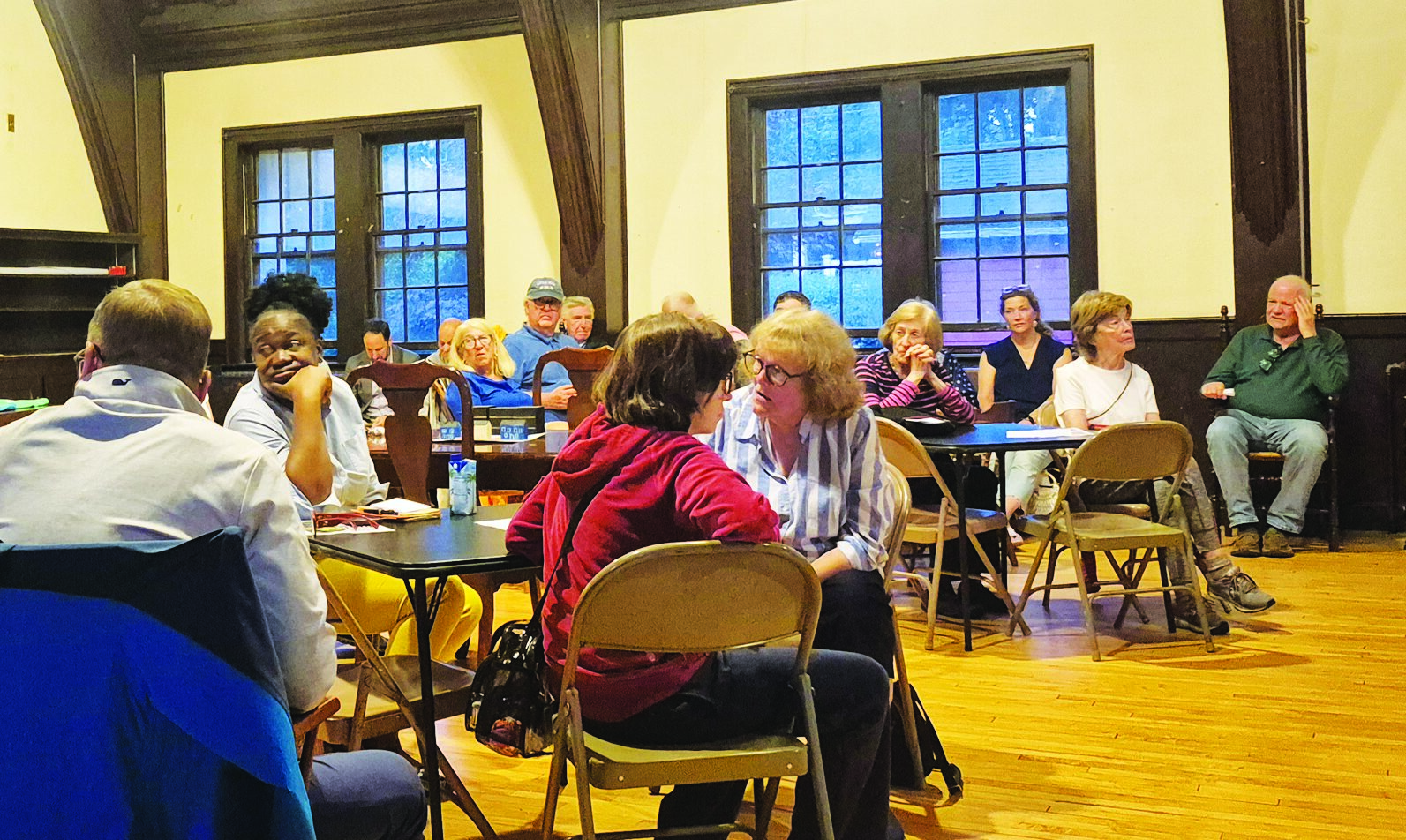
The Bellevue Hill Improvement Association (BHIA) met on Tuesday at the Emmanuel Church on Stratford Street in West Roxbury and discussed a host of issues around the community.
The biggest one was perhaps a reminder that the city’s Neighborhood Housing Zoning plan is still happening, and BHIA Board member Jay Buckley said the association had invited a representative from the Boston Planning Department to go over the timeline, but they did not come.
For a quick refresher, the city has not made much noise about its Neighborhood Housing Zoning Plan since the fall of 2025. The city’s pitch – https://gvimes.link/nbhdzning – is that much of West Roxbury is not zoning compliant, as much of it was built before zoning existed, and so anytime a resident wants to build a deck or install a dormer, they have to go through the Zoning Board of Appeals (ZBA) process.
That usually involves hiring a lawyer and sitting through the three-plus-hour meetings waiting to be called on. The ZBA has, in recent years, put much of that small-scale work into the ZBA subcommittee meeting, but that also runs three hours. And after that meeting, those agenda items are put on what is called a consent agenda and voted on en masse at the next regular ZBA meeting.
That was the city’s pitch. What was a little less prominent during those meetings – which were aimed at West Roxbury, Roslindale and Hyde Park – was the tenant’s ability of increasing the “small-scale” housing by making it as-of-right. Residents in West Roxbury felt – among other things – that the one-to-four units proposed by the city as small-scale could be too much.
And Buckley, during the meeting, reminded residents that this was coming.
“Which means the houses beside you today, which are single-family, could be converted to multi-family,” he said.
“Isn’t that what we want if there’s a housing crisis and our kids can’t get housing?” said Rev. Abigail Henrich.
“I’m not going to take a formal side on that,” Buckley replied.
Buckley also pointed out the zoning would also make it as-of-right for residents to add accessory dwelling units (ADUs) to their properties; that is, if they meet the fire code. District 6 City Councilor Ben Weber pointed out that most single-family homes in the city don’t have enough access for fire trucks to build an outbuilding for an ADU. The main pitch for these at the 2025 meetings was that homeowners would be able to add internal ADUs to current structures by reorganizing them.
Buckley said a draft plan is coming in the fall.
Also discussed at the meeting was the issue of zone fares for the MBTA Commuter Rail. Tickets for the train have their price dictated by how far they are from the city center – https://gvimes.link/znfrs
West Roxbury, Hyde Park and Roslindale are the only commuter rail stations inside the City of Boston but outside of Zone 1A, which has a $2.40 one-way ticket price. The Parkway, which includes Zone 1 and Zone 2, see their prices shoot up to $6.50 and $7 respectively.
State Rep. Bill MacGregor, State Sen. Michael Rush’s Chief of Staff Michael Munchbach, and Weber all said they’ve been supporting and working on legislation to get those stations – Roslindale Village, Readville, Hyde Park, Bellevue, Highland and West Roxbury – into the 1A zone, but in the last five years they’ve run into some issues.

MacGregor said it’s an issue of buy-in. Basically, the change would have to come from the state legislature, and many state legislators see no benefit to any changes, either way, to the MBTA system. He said they will continue to work on the legislation, but said that they will likely have to hold a complete revamping of the Commuter Rail Zone Fares map to get anything done.
“I don’t want to speak for all my colleagues, but the reps in Springfield or the Berkshires are not going to vote on this,” he said. “What’s hard is that it’s not affecting them. I try to explain to several of them what this is. But Michael (Giordanao) from my office and I were talking today about maybe a whole revamping of this zone system. That way, others will feel like they have a say.”
MacGregor, Weber, and Munchbach said the issue was something they were all focused on.
“This is something that is a priority for us, but I know it’s not a priority for Springfield or the Berkshires,” MacGregor said.
In other news, Weber went over the budgetary issues facing the city, mainly a $70 million shortfall the council and Boston Mayor Michelle Wu have been going back and forth on in the last few months.
Where to cut? That was the question. Weber touted that he was able to help secure funding for the neighborhoods where he could, but the main problem was that of health insurance. Basically, the city’s health insurers have stipulated that GLP-1 drugs are covered, and that, along with other external forces, has pushed up healthcare costs significantly for city workers.
Weber said that and tariffs, fuel costs, and other economic indicators have pushed the budget significantly. That’s on top of the required pay increases the city has to pay because of its collective bargaining agreements with different unions. He did stipulate, however, that the city did not approach the 2.5 percent levy increase limit imposed by Prop 2.5 – https://gvimes.link/prp2p5 – at a 2.1 percent increase.
Prop 2.5 basically says municipalities can’t increase their tax levy – which then rolls down into the tax rates and that whole commercial vs. residential rates fight Wu has been having with the state the last two years – more than 2.5 percent each year. No real reason for the calculation has been given since it was enacted in the 1980s, it just appeared to be an attractive number.
A municipality would have to have a ballot vote to increase the levy further than that, and residents may notice several outside municipalities dealing with this reality.
Weber said they squeezed the budget as much as possible to prevent most layoffs, and even with an increase in funding to the schools – the Boston Public Schools, the Boston Police Department and the Boston Fire Department were the only departments to see increases in the budget this year – some layoffs are still likely.
For more information on BHIA and for a more detailed look at its response to the Neighborhood Housing Rezoning Project, go to https://gvimes.link/bellevue
About the author
Jeff Sullivan Covers local news and community stories.
More in this section
Historic preservation gets a surprise role in new housing starts
September 17, 2026
Comments