News
Roslindale businesses in the old days
Lecture shows what it was like in the Rozzie of old
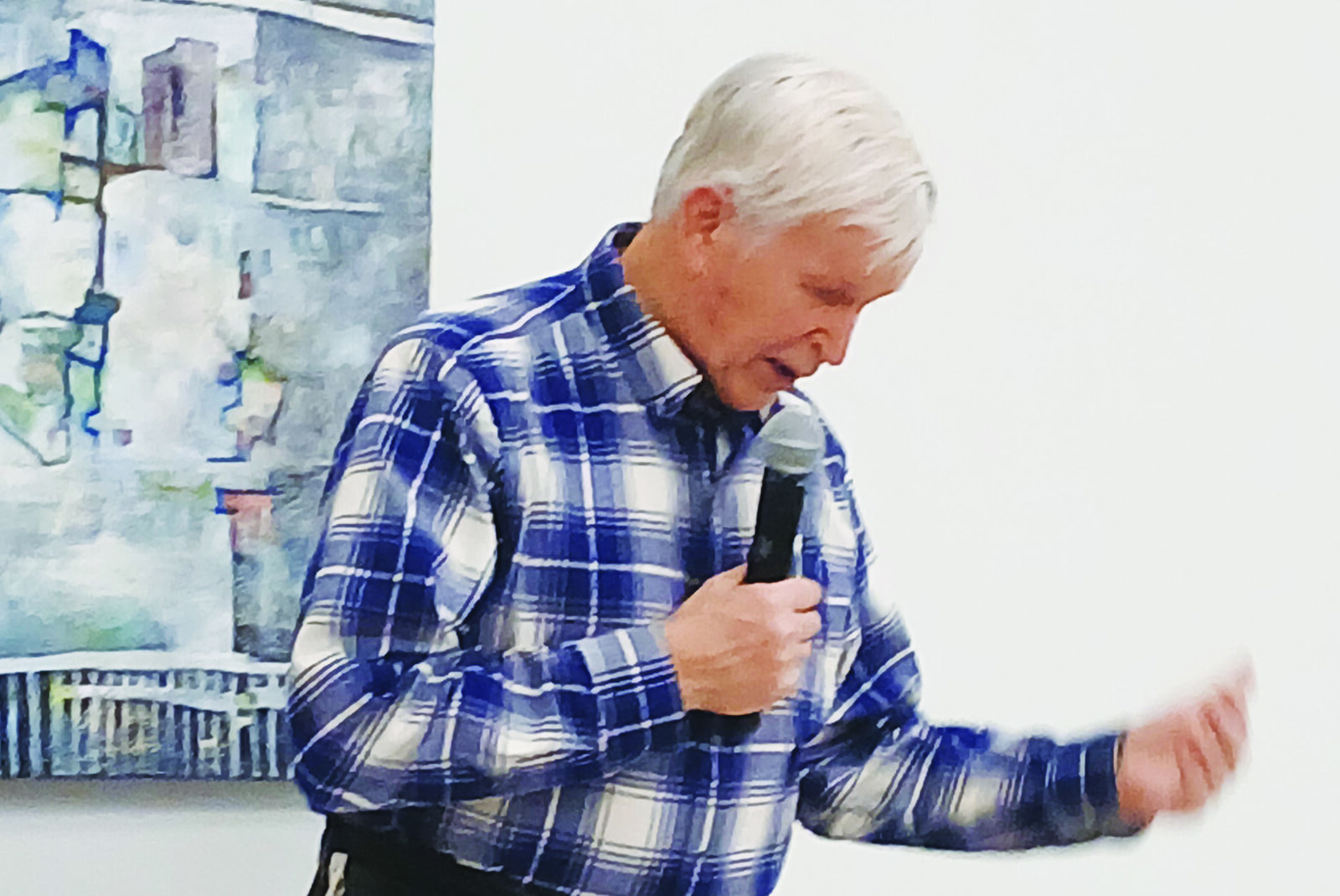
Despite the frigid temperatures, more than 35 residents filled the community meeting room at the Roslindale Boston Public Library on Thursday, Jan. 29 to hear neighborhood mainstay Joseph Porteleki describe how Roslindale businesses evolved from the 1890s onward to meet the needs of the neighborhood.
Porteleki is the well-known owner of Ace Hardware on Washington Street, and he was the first president of Roslindale Village Main Street, one of the first Main Street organizations in the country.
“I think I know about 90-plus percent of the people here,” he said. “What I’d like to do this evening is one of my favorite things. I’d like to look back in time, I’d like to take you on a journey: a little bit of time travel, sentimental longings, wishful affections.”
Porteleki is both a storyteller and collector of artifacts, and he spent the hour reminiscing, using an array of old photos, implements, and lists showing how closely business owners and customers interacted daily and depended on each other from the 1890s until World War I when Washington Street, between the Forest Hills train station and Roslindale Square, became a major transportation hub and business sector.
“So many things happened inside of 25 years, it’s mind-boggling,” said Porteleki.
As a natural extension of the trains that ended at Forest Hills, a horse and buggy offered further transport west and by the 1890s, there were horse-drawn street cars. Electric trolleys then replaced the horses and in 1909, the elevated streetcar came from the city to Forest Hills. Local groceries, hardware stores, and pharmacies sold everything families needed, like kerosene to light lamps or later, even gas. There was no need to leave the neighborhood.
“There was a pharmacy practically on every corner,” he said. “When prohibition came in 1920, pharmacies sold liquor for their medicinal purposes. Sundays came to be the busiest for liquor sales at the pharmacies.”
“Before church, you needed a drink,” Porteleki said.
Early on, power was coal-generated but then a company near Forest Hills made gas for use with interior lights and later cars. Roslindale, however, was also rural. There were wealthy landowners who owned sheep, horses, cows, and orchards. There were five-to-six dairies operating in the area until the 1960s.

A few of the early businesses remain. Davis Monuments on Washington Street opened in 1862 and managed deceased persons arriving at Forest Hills station, shipped by train during the Civil War. The company is still open today as is Puritan Ice Cream, around since 1902. Porteleki showed a copy of the permit given to the first person to own a car and gasoline in the area in 1917. “It was a Maxwell (later to become Chrysler) that was built in Pawtucket.”
A customer would first buy the chassis, the motor, and the transmission and then hire another company to put a body on it. Porteleki passed around a 1919 magazine ad for The Farnham Company on Arboretum Road that designed car bodies.
Porteleki talked wistfully about the changes in everyday life in Roslindale after World War II. The increase in the use of cars enabled customers to leave the neighborhood to shop at large stores and, later, malls. Local owners often extended credit to customers and suppliers offered credit to the owners, maintaining a strong personal and economic connection with customers.
With credit cards, financial agencies became creditors who cut out any personal connection, so local businesses suffered and many closed. As a business owner himself, Porteleki understands the loss of that relationship.
“The hardest thing in business is developing trust. Trust you can lose very quickly …you had to be honest and do your best and extend credit. Things have changed radically,” he said.
The presentation wrapped up with a few questions. Someone asked when the Five and Ten stores closed. “We had some on Corinth Street. Kresge’s, up until 1970-1972. They all went out of business because of malls,” said Porteleki. Someone asked what happened to the horse manure (and human sewage) generated before there were sewer and sanitation systems. Porteleki said it was used as fertilizer but added, “There was always more than you needed.”
More in this section
Historic preservation gets a surprise role in new housing starts
September 17, 2026
Comments
I wish the speaker had broadened his focus to include pre and post war Roslindale. Business in the square has a very long history. I can name the stores from my childhood in 60s/70s but not even sure that was the apex of activity. You could purchase everything a family needed. My mom worked at Parke Snows, on South St., up until the destructive fire. Dad was a regular at Wallpaper City. Kiddie.Land was where you got school uniforms and other gear, Diane's bakery for corn muffins, my uncle's photography studio, Rialto barbershop and similarly named theatre, Kennedy butter and eggs, Tony's market, Pearl & McLaughlin shoe repair, Boschettos, Vosto.(sp?) I do like sweets and so many more places of longevity but now gone. The Adams Post.formerly on Belgrade Ave, raised the memorial to local WW1 soldiers from Roslindale. My GGF was killed in an industrial accident at the merge of South & Washington streets in 1913. He worked for the nascent Water Dept. His sons later opened the "Happy Hour" which developed quite the reputation. It's so valuable to remind older residents, to remember, and newer residents Roslindale's long heritage.